
The Transformation Paradox: Your Employees Are Ready for AI. Is Your Organization?
This article is based on Microsoft’s 2026 Work Trend Index Annual Report, “Agents, human agency, and the opportunity for every organization.”
Microsoft’s 2026 Work Trend Index surveyed 20,000 workers and analysed trillions of productivity signals, and the headline finding is uncomfortable: in most companies, the people are ahead of the systems around them. Here is what that means, and how to close the gap.
Your employees have quietly become AI-ready. Your operating model has not. That is the tension at the centre of Microsoft’s latest research, and it is the single most important thing for any IT or business leader to understand right now. Workers are using AI in advanced, resourceful ways, taking on higher-value work and producing things they could not a year ago. But the culture, the manager habits, the incentives, and the governance around them have not caught up. The result is a gap between what people can now do and what their organizations are built to support.
Microsoft has a name for this gap: the Transformation Paradox. And the data behind it points to a clear, and oddly hopeful, conclusion. The biggest lever for AI success is not buying more tools or hiring more talent. It is redesigning the organization around the people you already have.
THE SHORT VERSION
- Microsoft’s 2026 Work Trend Index finds that employees are adopting AI faster than their organizations can support, creating what it calls the Transformation Paradox.
- Only about 1 in 5 AI users sit in the “Frontier” zone where individual skill and organizational readiness reinforce each other. Many capable people are actively held back.
- The decisive factor is organizational, not individual: culture, manager support, and talent practices account for roughly twice the AI impact of individual mindset and effort.
- The fix is a deliberate redesign of how work, management, and governance operate, with IT and security playing a central role in governing AI agents at scale.
What the Data Actually Says
Microsoft mapped its survey respondents on two axes: how capable each person is with AI, and how ready their organization is to support that capability. The result sorts everyone into five groups, and the distribution tells the whole story.
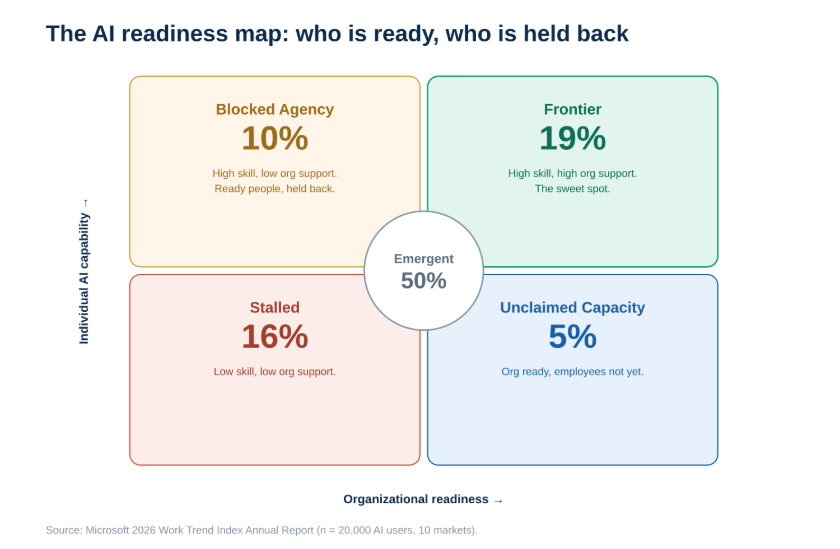
Only 19% of AI users land in the Frontier zone, the sweet spot where strong individual capability meets a supportive organization. The most striking group is the roughly 10% in what Microsoft calls “blocked agency”: skilled, motivated people whose organizations simply have not built the systems to let them apply what they can do. Another 16% are stalled, with low support and low capability, and a small 5% sit in “unclaimed capacity,” where the organization is ready, but employees have not yet caught up. The largest share, about half, sits in the messy middle, where both individual practice and organizational conditions are still forming.
The pattern underneath is consistent: in many companies, employees are moving faster than the organizations around them.
The most valuable people in your company may be the ones your systems are quietly holding back.
Why the Gap Exists
If employees are ready, why are so many stuck? The report points to a self-defeating set of incentives. A majority of AI users (65%) fear falling behind if they do not adapt quickly, yet nearly half (45%) say it feels safer to focus on hitting current goals than to redesign how they work with AI. And only 13% feel rewarded for reinventing their work when the results are not immediate.
In other words, the same pressure that drives people to adopt AI also pushes them to play it safe. The organization asks for transformation but rewards the old way of working. It does not help that leadership often is not aligned: only about a quarter of AI users say their leadership is clearly and consistently aligned on AI.
This is why Microsoft frames the paradox as a systems problem, not a people problem. And systems do not fix themselves. They have to be redesigned. We explored the foundations of that redesign in our Agentic AI Readiness Checklist for 2026.
The Fix Is Organizational, Not Individual
Here is the finding every leader should sit with. When Microsoft tested dozens of factors against the real impact employees get from AI, the strongest predictors were not individual at all. They were organizational.
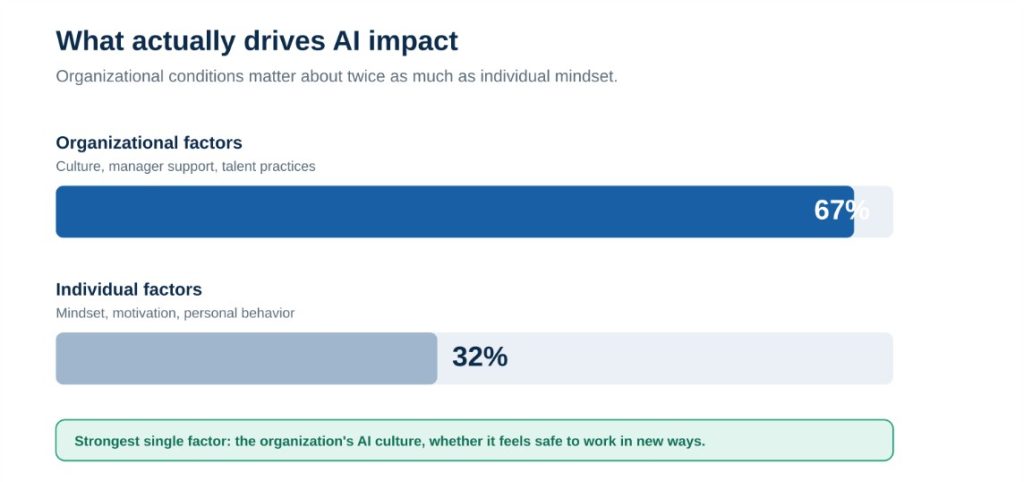
Culture, manager support, and talent practices accounted for roughly twice the reported AI impact of individual mindset and behaviour. The single strongest factor of all was the organization’s AI culture, whether it feels safe to suggest new ways of working, whether experimentation is encouraged, and whether people trust their own ability to use AI well.
Manager behaviour matters enormously here. When managers actively modelled AI use themselves, the report found meaningful lifts in how much value employees got from AI, how critically they thought about its output, and how much they trusted agentic AI. The takeaway is practical: the fastest way to move people from “blocked” to “Frontier” is not another tool rollout. It is leaders who set a clear strategy and managers who make it safe, expected, and rewarded to work in new ways.
What This Means for IT Leaders Specifically
The Work Trend Index is clear that this redesign is not only a culture exercise. As organizations scale AI, the number of active agents in the Microsoft ecosystem has grown many times over year on year, and someone has to govern them. The report puts IT at the centre of that shift: agents should be treated as managed entities with their own identities, permissions, policy enforcement, and lifecycle management. In Microsoft’s framing, IT becomes the control plane for agent operations, extending the same rigor already applied to people and applications.
For security leaders, the same scaling introduces new risks the report names directly: data exfiltration, unintended system actions, and unauthorized access. The answer is to build monitoring, policy enforcement, and auditability into the platform itself, so trust becomes a structural property rather than an afterthought. This is exactly the territory we cover in AI Agents Are Here: But Are They Working for You or Against You? and in our work on agentic AI for enterprises.
The organizations that get this right, Microsoft argues, become Learning Systems: places where the work agents do generate signals, those signals get captured and shared rather than trapped locally, and the institution gets smarter with every cycle. Microsoft calls the result Owned Intelligence, know-how that is unique to your firm and hard for competitors to copy.
Where to Start
You do not close the Transformation Paradox with a single initiative. But the report points to a clear sequence, and it starts at the top.
- Set the strategy and align leadership. Decide where AI changes how work gets done, and make sure leaders speak with one voice. Only a quarter of workers see consistent leadership alignment today, so this is a real differentiator.
- Equip managers to model and reward AI use. Managers operationalize the strategy. Give them permission and expectation to use AI openly, set quality standards, and reward reinvention even before results are obvious.
- Build governance for agents from day one. Treat agents as managed identities with permissions, monitoring, and lifecycle controls. This is where IT and security make AI safe to scale.
- Turn local wins into shared routines. Capture what works, document the handoffs between humans and agents, and spread it across teams so insight compounds.
This is precisely the kind of organizational redesign that benefits from an experienced Microsoft partner. Cloud 9 Infosystems has spent 16-plus years helping US enterprises move from AI experimentation to durable, governed value across healthcare, financial services, and enterprise IT.
The Bottom Line for Leaders
The most encouraging part of Microsoft’s research is also the most demanding. The barrier to AI value is not your people, and it is not the technology. It is the operating model in between. That means the gap is yours to close, and the organizations that close it first will pull ahead in ways that get harder to catch every quarter.
The question is no longer whether your employees are ready. It is whether your organization is built to unlock what they can already do.
You can read Microsoft’s full 2026 Work Trend Index on the Microsoft WorkLab site.
Is Your Organization Ready to Capture the Value Your People Are Already Creating?
Microsoft’s research is clear that the gap is organizational, and closing it is a design choice. Cloud 9 Infosystems will help you assess where your organization sits on the AI readiness map and build the operating model, governance, and Microsoft platform foundation to move into the Frontier zone.
Frequently Asked Questions
What is the Microsoft 2026 Work Trend Index?
It is Microsoft’s annual research report on how AI is changing work, based on a survey of 20,000 workers across 10 countries and analysis of aggregated, anonymized Microsoft 365 productivity signals. The 2026 edition focuses on agents, human agency, and how organizations can capture the value of AI.
What is the Transformation Paradox?
The Transformation Paradox is Microsoft’s term for a gap the research uncovered: employees are ready and willing to reinvent how they work with AI, but the systems around them, including metrics, incentives, and norms, still reward the old way of working. The same forces driving AI adoption end up holding it back.
What is a Frontier Firm or Frontier Professional?
Frontier Firms are organizations pulling ahead by redesigning their operating model around AI. Frontier Professionals are the most advanced AI users, who use agents for multi-step work, routinely rethink workflows, and help set shared AI standards. In Microsoft’s research they are a small but disproportionately valuable share of AI users.
Why does Microsoft say organizational readiness matters more than individual skill?
When Microsoft tested many factors against the real impact employees get from AI, organizational conditions like culture, manager support, and talent practices accounted for roughly twice the impact of individual mindset and behaviour. The single strongest factor was the organization’s AI culture.
What role do IT and security play in AI readiness?
A central one. As organizations scale AI agents, the report recommends treating agents as managed entities with identities, permissions, policy enforcement, and lifecycle management, with IT acting as the control plane and security building monitoring and auditability into the platform itself.
How can our organization become more AI-ready?
Start by aligning leadership on a clear AI strategy, equipping managers to model and reward AI use, building governance for agents from the outset, and capturing local wins into shared, repeatable practices. A readiness assessment with a Microsoft partner can map where your organization sits today and what to prioritize.
Recent Posts
Latest Blogs

FabCon Europe 2026: What Fabric IQ and Data Agents Mean for Your Business
Fabric IQ in Microsoft Copilot is now generally available and on by default. Learn what it means for Power BI, its current limits, and a 6-step plan to get your semantic models ready.

Azure Virtual Desktop Regional Host Pools Are Now GA. Here Is Why Your Next Host Pool Should Be Regional.
Azure Virtual Desktop regional host pools are now generally available. Learn how they improve resiliency, reduce shared regional dependencies, support data sovereignty, and help IT teams build stronger AVD disaster recovery designs.

Generative AI Data Security: How to Prepare Microsoft 365 Before You Roll Out Copilot
Generative AI data security starts with securing the data Microsoft 365 Copilot can access. Learn how to fix oversharing, protect sensitive content, control AI use and prepare your Microsoft 365 environment for a safer Copilot rollout.