
Why SMBs Are Adopting Azure Virtual Desktop Over Traditional IT Setups
Introduction: A New Era of IT for SMBs
Key Challenges with Traditional VDI for SMBs
- High Upfront Costs: Buying servers, storage, networking, and licenses requires large capital and multi-year commitments.
- Limited IT Bandwidth: Small IT teams spend too much time patching hypervisors, managing storage, and troubleshooting VDI instead of strategic work.
- Scalability Issues: Overprovisioning hardware to handle peak use wastes resources; under-provisioning causes slow logins and frustration.
- Fragmented Device Management: Keeping desktop images, apps, and security policies consistent across PCs, Macs, tablets, and thin clients often means juggling multiple tools.
- Security & Compliance Overhead: On-prem VDI demands firewalls, VPNs, antivirus, and constant patching—plus detailed audit reporting to meet regulations like HIPAA, PCI, and GDPR.
How Azure Virtual Desktop Solves These Pain Points
- Defender for Cloud & Security Center: Continuous threat detection and vulnerability scanning.
- Azure Active Directory & Conditional Access: Enforce MFA and device-compliance checks before granting desktop access.
- Azure Policy & Log Analytics: Automate compliance checks and centralize logs for audit-ready reporting.
AVD vs. Traditional IT: A Comparative Overview
| Key Attribute | Capital Investment | Azure Virtual Desktop (AVD) |
|---|---|---|
| Capital Investment | High upfront hardware costs | Pay-as-you-go cloud model |
| Remote Access | VPN-dependent, less secure | Seamless, secure from any device |
| Scalability | Hardware upgrades required | Instant, elastic scalability |
| Management | On-site IT teams required | Centralized cloud management |
| Security & Compliance | Local infrastructure risks | Microsoft 365-level security & controls |
Overcoming AVD Adoption Barriers
- It’s too expensive for small businesses.
- Migration will disrupt our operations.
- Cloud desktops aren’t secure.
These clarifications demonstrate that adopting AVD is not only feasible but low risk when supported by the right guidance and planning.
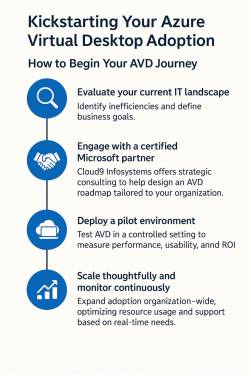
How to Begin Your AVD Journey
For SMBs aiming to modernize their IT infrastructure, adopting AVD is a logical and manageable first step that follows a clear, structured roadmap. Taking the first step toward Azure Virtual Desktop doesn’t have to be overwhelming. Begin by taking stock of your existing environment pinpoint where bottlenecks, costs, or security gaps are holding you back. Next, partner with experienced advisors who have guided other businesses through the transition, ensuring your migration plan aligns with your unique needs and budget. Then, launch a small-scale trial to validate performance and user experience before rolling out broadly. Finally, once you see positive results, expand your cloud-based desktop solution gradually, fine-tuning resources and support along the way. With this phased approach, you’ll move from planning to production in weeks delivering the flexibility, security, and simplicity your team needs to thrive.
Case Study: Secure, High-Performance Remote Desktops with Azure Virtual Desktop
- 30 % Faster Login Times
- 20 % Cost Savings
- Robust Security & Compliance
- 50 % IT Bandwidth Reclaimed
Conclusion: Empowering SMBs with Modern IT Infrastructure
Azure Virtual Desktop represents a transformational opportunity for SMBs to overcome the limitations of traditional IT and embrace a secure, scalable, and efficient future. By enabling remote productivity, reducing operational costs, and enhancing IT manageability, AVD is more than a platform it’s a catalyst for business growth. As SMBs increasingly navigate hybrid workforces, rising cyber threats, and evolving client expectations, AVD positions them to adapt quickly and compete confidently.
Partner with Cloud 9 Infosystems: A Trusted Microsoft Solutions Partner
Top 5 FAQs About Azure Virtual Desktop
- 1. Is Azure Virtual Desktop viable for companies with fewer than 50 employees?
- 2. Can I integrate AVD with my existing Microsoft 365 environment?
- 3. What devices are supported for accessing AVD?
- 4. How long does it take to implement AVD?
- 5. Can I retain parts of my on-premises infrastructure with AVD?
Recent Posts
Latest Blogs

Azure Virtual Desktop Regional Host Pools Are Now GA. Here Is Why Your Next Host Pool Should Be Regional.
Azure Virtual Desktop regional host pools are now generally available. Learn how they improve resiliency, reduce shared regional dependencies, support data sovereignty, and help IT teams build stronger AVD disaster recovery designs.

Generative AI Data Security: How to Prepare Microsoft 365 Before You Roll Out Copilot
Generative AI data security starts with securing the data Microsoft 365 Copilot can access. Learn how to fix oversharing, protect sensitive content, control AI use and prepare your Microsoft 365 environment for a safer Copilot rollout.

FabCon Europe 2026: What Fabric IQ and Data Agents Mean for Your Business
Microsoft 365 Copilot has reached 30 million paid seats, but licenses alone do not guarantee value. Learn how to measure adoption, track ROI, optimize usage, and right-size Copilot licensing before your next renewal.