

Agentic AI in the Enterprise: Moving Beyond Copilot to Intelligent Workflows
The Next Evolution of Enterprise AI
For many organizations, Microsoft Copilot has been the first practical step into enterprise AI. Employees use AI assistants to summarize meetings, draft content, analyze information and improve productivity. However, enterprise AI is entering a new phase.
Organizations are increasingly exploring Agentic AI where intelligent systems do more than assist. They can understand goals, plan actions, interact with business systems, retrieve information and execute workflows within predefined guardrails. Microsoft describes agents as systems that can interpret intent, plan work, use tools and take action on behalf of users.
From mid-sized businesses in Downers Grove, Illinois, to global enterprises operating across multiple regions, organizations are beginning to look beyond productivity gains and toward intelligent workflow transformation.
The result is a significant shift in how work gets done across the enterprise.
What Is Agentic AI?
Agentic AI refers to AI systems that can pursue goals and perform actions with varying levels of autonomy while operating within governance and security controls.
According to Microsoft’s Agents Hub, agents go beyond simply generating responses. They can:
- Interpret intent
- Plan work
- Use tools
- Access enterprise knowledge
- Take action on behalf of users
- Collaborate across workflows and systems
This is an important distinction.
A traditional AI assistant typically responds to a prompt while an AI agent can execute a sequence of actions required to complete a business objective.
For example:
Copilot Assistant
- Drafts an email
- Summarizes a report
- Answers questions
AI Agent
- Reviews a customer request
- Retrieves related records
- Creates a service case
- Assigns tasks
- Notifies stakeholders
- Tracks completion status
All while operating within defined business policies.
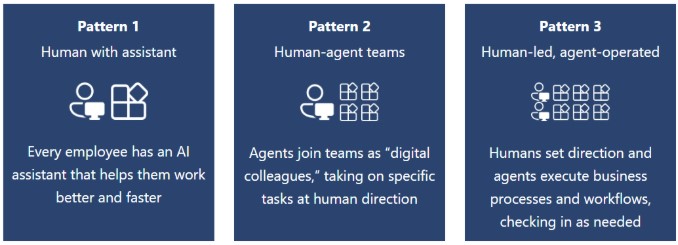
Microsoft’s AI maturity model showing the evolution from AI assistants to human-agent teams and agent-operated workflows.
From Human Assistance to Human-Agent Collaboration
Microsoft’s vision for enterprise AI maturity highlights a progression from AI assistance toward increasingly sophisticated human-agent collaboration. Organizations often begin with AI assistants that improve individual productivity, then move toward human-agent teams where AI agents act as digital colleagues and eventually adopt human-led, agent-operated workflows where people define objectives and agents execute business processes.
This progression is changing how enterprises approach automation.
Traditional automation follows predefined workflows whereas Agentic AI can dynamically determine the next best action based on context, business objectives, enterprise knowledge and organizational policies.
Looking for the Difference Between AI Agents and Traditional Automation?
Many organizations still confuse chatbots, RPA, workflow automation, copilots and AI agents.
Read our related blog: Agentic AI vs Traditional Automation: What’s the Difference?
In that article, we explore how AI agents differ from traditional automation technologies and where each approach delivers the greatest value.
Why Enterprises Are Looking Beyond Copilot
The first wave of enterprise AI focused on individual productivity and the next wave focuses on business process transformation.
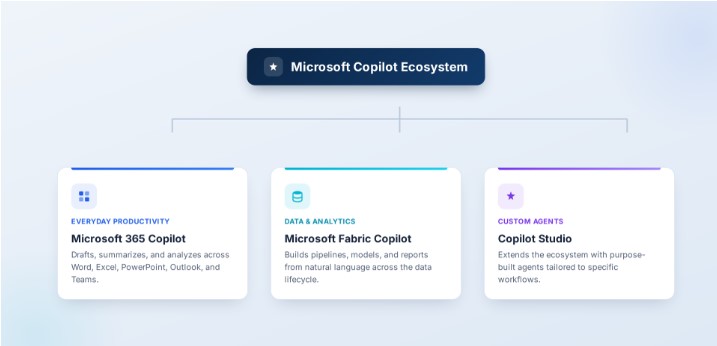
The Microsoft Copilot Ecosystem extends beyond productivity assistants to include data and analytics capabilities through Microsoft Fabric Copilot and custom AI agents through Copilot Studio, helping organizations move toward intelligent workflow automation.
Organizations are increasingly asking:
- How can we reduce manual work?
- How can we automate complex business processes?
- How can we extract more value from enterprise applications?
- How can we turn insights into actions?
At Cloud 9 Infosystems, we see growing interest from organizations looking to connect AI with enterprise applications, Microsoft Fabric, Power Platform, Dynamics 365 and analytics platforms to create intelligent business workflows.
The conversation is no longer about using AI instead it is becoming about embedding AI into how business works.
Real Enterprise Examples of Agentic AI in Action
The value of Agentic AI emerges when agents are connected to real business processes, trusted enterprise data and operational systems.
HR Onboarding Agent
A new employee joins the organization. Instead of manually coordinating activities across HR, IT and Facilities teams, an AI agent can:
- Create onboarding requests
- Trigger approvals
- Schedule induction sessions
- Track completion status
- Answer policy-related questions
The process still includes human oversight, but significantly reduces administrative effort.
Sales Operations Agent
Sales teams often spend hours gathering information and updating systems.
An AI agent can:
- Research account information
- Generate customer summaries
- Update CRM records
- Recommend next actions
- Create follow-up activities
This allows sales professionals to spend more time building customer relationships and less time managing administrative tasks.
Finance Compliance Agent
Finance teams regularly review large volumes of transactional information.
An AI agent can:
- Analyze financial data
- Flag compliance exceptions
- Generate reports
- Route approvals
- Escalate unusual transactions for review
This improves consistency while allowing finance professionals to focus on higher-value decision-making.
Customer Service Agent
Customer expectations continue to rise.
An AI agent can:
- Analyze customer requests
- Search internal knowledge repositories
- Create support cases
- Recommend resolutions
- Coordinate escalations
This enables faster and more consistent customer experiences.
Agentic BI Scenario: From Dashboards to Decisions
This is where Agentic AI becomes especially interesting for data-driven organizations.
Traditionally, dashboards tell users what happened.
An AI agent can go further by:
- Monitoring KPIs continuously
- Detecting anomalies
- Generating executive summaries
- Recommending actions
- Triggering workflows
Instead of waiting for users to analyze reports, intelligent agents help organizations move from reporting to action. For organizations investing in Microsoft Fabric, Power BI and enterprise data modernization, this represents an exciting evolution in business intelligence.
Explore Agentic AI Solutions
Want to understand how AI agents can integrate with Microsoft 365, Dynamics 365, Power Platform, Microsoft Fabric, Power BI, and Azure?
Explore Cloud 9 Infosystems’ Agentic AI Solutions and discover how intelligent agents can transform enterprise workflows.
Microsoft’s Agent Ecosystem: Building Blocks for Agentic AI
Microsoft’s ecosystem provides multiple options for building and deploying AI agents.
Microsoft Foundry
Microsoft Foundry serves as Microsoft’s AI app and agent factory, allowing organizations to build, optimize, deploy, and govern AI agents at scale.
Microsoft Copilot Studio
Copilot Studio enables organizations to create low-code AI agents that connect to business processes, data sources, and enterprise systems.
Microsoft Entra Agent ID
Microsoft has introduced agent-specific identity and governance capabilities to support secure deployment and management of enterprise AI agents.
Microsoft Agent Framework
Organizations requiring advanced orchestration can use Microsoft’s framework and developer tools to build sophisticated agent-driven workflows.
Ready to Identify Your First Agentic AI Use Case?
Many organizations know they want to adopt AI but struggle to identify the best starting point.
Cloud 9 Infosystems offers a Free Agentic AI Discovery and Proof of Concept Workshop to help organizations:
- Identify high-value use cases
- Assess enterprise application readiness
- Evaluate data maturity
- Define governance requirements
- Build an implementation roadmap
Book Your Free Agentic AI POC Consultation with Cloud 9 Infosystems
Agentic AI and Data-Driven Enterprises
One of the most significant opportunities for Agentic AI lies at the intersection of AI, Enterprise Applications, Data Platforms and Business Intelligence.
Historically, business intelligence focused on dashboards and reporting.
Tomorrow’s enterprises may rely on AI agents that:
- Monitor business performance
- Analyze operational data
- Generate recommendations
- Initiate workflows
- Coordinate actions across departments
Organizations are increasingly looking for ways to connect Microsoft Fabric, Power BI, Dynamics 365, and AI agents to create intelligent business ecosystems where data not only informs decisions but also drives action.
This is where Cloud 9’s expertise in Data & BI, Enterprise Applications, and AI becomes particularly valuable.
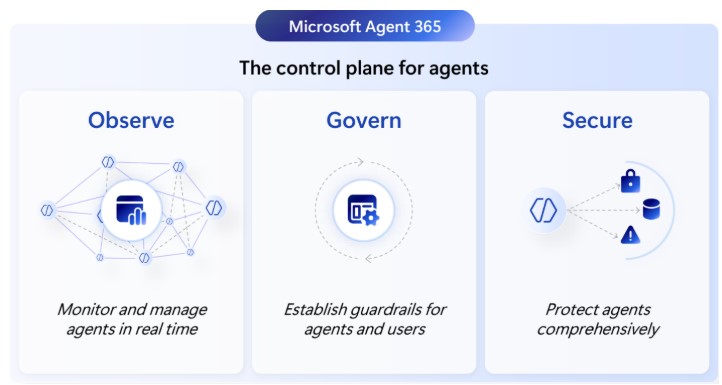
Microsoft Agent 365 provides a control plane for enterprise AI agents, enabling organizations to observe agent activity, establish governance guardrails, and secure agent operations at scale.
While the excitement around AI agents continues to grow, successful adoption requires strong governance.
Microsoft emphasizes security, identity, visibility, auditability, and responsible AI practices across its agent ecosystem.
Organizations should focus on:
- Data security
- Identity management
- Human oversight
- Regulatory compliance
- Monitoring and observability
- Responsible AI frameworks
The goal is not unrestricted automation but trusted and governed automation.
How Cloud 9 Helps Your Business Adopt Agentic AI
At Cloud 9 Infosystems, we help businesses move beyond experimentation and into enterprise-scale AI adoption.
Our capabilities include:
- Agentic AI Solutions: Designing and implementing AI agents using Microsoft Foundry and Copilot Studio.
- Enterprise Applications: Extending Dynamics 365 and Power Platform with intelligent AI-driven workflows.
- Data & BI Modernization: Connecting AI agents with Microsoft Fabric, Power BI, Azure data platforms, and enterprise knowledge sources.
- Governance & Responsible AI: Implementing frameworks that balance innovation with security, compliance, and control.
- Managed AI Operations: Providing ongoing optimization, monitoring, and support for enterprise AI initiatives.
The Future Is Not AI-Assisted Work. It Is AI-Enabled Work
Copilots have helped organizations improve productivity but now, Agentic AI is helping organizations reimagine business processes.
The organizations that succeed in the next phase of AI adoption will not simply use AI to work faster but they will use it to transform how work gets done.
Whether organizations operate locally in Chicago, Illinois, across the United States, or globally, the challenge remains the same: turning AI investments into measurable business outcomes while maintaining governance, compliance and trust.
By combining Microsoft Foundry, Copilot Studio, Enterprise Apps, Microsoft Fabric, Power BI and Agentic AI, businesses have an opportunity to create intelligent workflows that are scalable, accountable, and outcome-driven.
Ready to Build Your Agentic AI Strategy?
Cloud 9 Infosystems helps organizations design, build, and scale AI-powered business solutions using Microsoft’s latest AI technologies.
Whether you’re exploring:
- Agentic AI
- Microsoft Foundry
- Copilot Studio
- Enterprise Applications
- Microsoft Fabric
- Power BI
- Intelligent Automation
our experts can help turn AI ambition into measurable business value.
Contact Cloud 9 Infosystems today to discuss your AI roadmap or schedule a free Agentic AI Proof of Concept workshop.
Frequently Asked Questions
What is the difference between Copilot and Agentic AI?
Microsoft Copilot primarily assists users by generating content, answering questions, summarizing information, and improving productivity. Agentic AI goes beyond assistance by enabling AI agents to plan work, use tools, access enterprise systems, and execute tasks toward achieving business goals. Microsoft describes agents as systems that can interpret intent, plan actions, and take action on behalf of users.
How are AI agents different from traditional workflow automation?
Traditional automation follows predefined rules and workflows. AI agents can adapt to context, retrieve information, reason through complex scenarios, and determine the next best action within established guardrails.
If you’d like a deeper comparison, read our related article: Agentic AI vs Traditional Automation: What’s the Difference?
What business processes can benefit from Agentic AI?
Agentic AI can support a wide range of enterprise processes, including:
- Employee onboarding
- Customer service operations
- Sales and CRM management
- Finance and compliance workflows
- Procurement processes
- IT service management
- Business intelligence and analytics
Organizations are increasingly using AI agents to automate repetitive activities while improving productivity and decision-making.
Can AI agents work with Microsoft 365, Dynamics 365, Power Platform, and Microsoft Fabric?
Yes. Microsoft’s agent ecosystem, including Microsoft Foundry and Microsoft Copilot Studio, enables organizations to build AI agents that integrate with enterprise applications, business workflows, knowledge sources, and data platforms. This allows AI agents to retrieve information, trigger actions, and automate business processes across Microsoft technologies.
Is Agentic AI secure for enterprise use?
Enterprise-grade AI deployments require strong governance, security, and compliance controls. Microsoft emphasizes identity management, role-based access control, agent governance, auditability, observability, and Responsible AI practices across its agent ecosystem. Organizations should ensure AI agents operate within defined permissions and human oversight frameworks.
How can organizations get started with Agentic AI?
A successful Agentic AI initiative typically begins with identifying high-value business use cases, assessing data readiness, establishing governance policies, and selecting the right technology platform.
Many organizations start by:
- Defining business objectives
- Identifying repetitive or decision-intensive workflows
- Connecting enterprise data sources
- Building pilot AI agents
- Measuring business outcomes before scaling
Cloud 9 Infosystems helps organizations evaluate readiness, build proof-of-concept solutions, and implement enterprise-grade AI agents using Microsoft Foundry, Copilot Studio, Enterprise Applications, Microsoft Fabric, and Power BI.
What role does Agentic AI play in Business Intelligence (BI)?
Traditional BI platforms help organizations understand what happened. Agentic AI helps organizations determine what should happen next.
By integrating AI agents with Microsoft Fabric and Power BI, organizations can:
- Monitor KPIs automatically
- Detect anomalies in real time
- Generate executive summaries
- Recommend actions
- Trigger workflows based on business events
This enables businesses to move from static reporting toward intelligent, action-oriented analytics.
Why should organizations invest in Agentic AI now?
Enterprise AI is rapidly evolving from productivity-focused assistants to intelligent systems capable of supporting and executing business processes. Organizations that start building governance frameworks, data foundations, and AI capabilities today will be better positioned to unlock greater efficiency, faster decision-making, and competitive advantages in the future. Microsoft’s growing investment in agents, Microsoft Foundry, Copilot Studio, and enterprise AI governance reflects the increasing importance of Agentic AI in modern business transformation.
Recent Posts

FabCon Europe 2026: What Fabric IQ and Data Agents Mean for Your Business
Fabric IQ in Microsoft Copilot is now generally available and on by default. Learn what it means for Power BI, its current limits, and a 6-step plan to get your semantic models ready.

Azure Virtual Desktop Regional Host Pools Are Now GA. Here Is Why Your Next Host Pool Should Be Regional.
Azure Virtual Desktop regional host pools are now generally available. Learn how they improve resiliency, reduce shared regional dependencies, support data sovereignty, and help IT teams build stronger AVD disaster recovery designs.

Generative AI Data Security: How to Prepare Microsoft 365 Before You Roll Out Copilot
Generative AI data security starts with securing the data Microsoft 365 Copilot can access. Learn how to fix oversharing, protect sensitive content, control AI use and prepare your Microsoft 365 environment for a safer Copilot rollout.

Join Us on the Journey to Transforming Futures - Contact Us!
Schedule a meeting with our experts or fill out the form for a free assessment of your environment today!


*Cloud 9 reserves the right for free assessment eligibility.