

What Is Generative AI and How Is It Changing Workplace Productivity?
Workplace productivity has traditionally been improved through faster applications, better collaboration tools, and greater process automation. Generative AI introduces another layer of opportunity: the ability to help employees create, understand, transform, and communicate information using natural language.
From drafting a customer proposal to summarizing a complex document, generative AI can reduce the time employees spend moving from an idea to a usable first version. However, the future of workplace productivity will not be determined by how much content AI can generate. It will depend on how effectively organizations combine AI capabilities with human judgment, trusted data, security, governance, and measurable business objectives.
What Is Generative AI in the Workplace?
Generative AI refers to AI systems that can create or transform content such as text, images, code, summaries, presentations, and structured responses. Employees provide an instruction or prompt, and the system generates an output based on its underlying model and any context made available to it.
Generative AI is often discussed alongside two related but distinct approaches:
Approach | How It Works | Role in the Workplace |
Traditional automation | Follows predetermined, rule-based logic | Executes repeatable, structured tasks |
Generative AI | Creates or transforms content from a prompt and available context | Augments knowledge work — drafting, summarizing, exploring, comparing, communicating |
Agentic AI | Plans and takes actions across systems | May execute multistep processes with less direct human input |
In a workplace productivity context, generative AI is primarily used to augment knowledge work rather than to act on its own.
According to Microsoft Learn, large language models are central to enterprise generative AI applications, but a complete solution requires additional components for user interactions, security, privacy, and operational management. Microsoft also recommends applying an AI lifecycle and LLMOps practices to support the development, deployment, and continuous improvement of these applications.
That distinction matters. Providing access to a language model is not the same as building a trustworthy enterprise productivity solution.
How Generative AI Can Improve Workplace Productivity
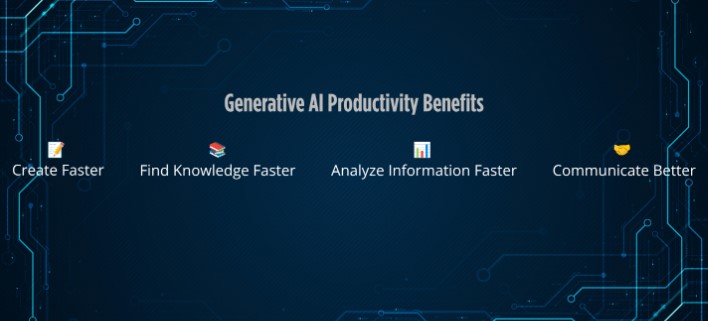
- Accelerating Business Content Creation
Many workplace tasks begin with assembling information into a usable format. Employees write proposals, reports, campaign briefs, presentations, emails, policies, and internal announcements every day.
Generative AI can help:
- Create a structured first draft
- Rewrite content for a specific audience
- Adjust tone and reading level
- Turn notes into an organized document
- Generate alternative headlines or campaign concepts
- Transform a report into an executive summary
The greatest benefit is often not eliminating the task. It is reducing the effort required to reach a strong starting point. Employees can spend more time validating facts, improving the argument, and adapting the material to the business context.
- Reducing Information Overload
Modern employees work across documents, messages, presentations, spreadsheets, and collaboration platforms. Finding and understanding the right information can consume a significant part of the working day.
Generative AI can summarize long materials, identify recurring themes, compare documents, explain technical concepts, and surface relevant points through conversational interactions. This can make organizational knowledge easier to use, provided the AI experience is grounded in authorized and reliable information.
Microsoft Learn highlights grounding as an important part of workplace AI. Grounding gives an AI system relevant context that can improve the usefulness of its response. Employees must still validate the output before relying on it.
- Supporting Analysis and Decision Preparation
Generative AI can help employees organize qualitative information, explain patterns, suggest questions, and communicate analytical findings. It can also make data-related work more accessible by translating a business question into a clearer analytical approach.
This does not make the system a substitute for accountable decision-making. Rather, it can serve as a productivity aid that helps people prepare inputs for a decision more quickly.
Organizations should maintain clear boundaries between:
- AI-generated suggestions
- Verified organizational facts
- Professional analysis
- Final human decisions
This separation is especially important where accuracy, compliance, customer trust, or employee outcomes are involved.
- Improving Communication and Accessibility
Employees often need to adapt the same information for executives, technical teams, customers, and partners. Generative AI can help restructure content for different audiences, explain acronyms, simplify complex passages, and create consistent summaries.
Used thoughtfully, these capabilities can improve the accessibility and clarity of workplace communication. However, AI-generated language should always be reviewed for accuracy, cultural context, tone, and unintended bias.
Where Organizations Can Start
The best generative AI use cases are usually frequent, measurable, and easy to review. Examples include:
Department | Example Use Cases |
Marketing | Campaign brief creation, content ideation, audience-specific message variations, product description drafting, content summarization and repurposing |
Sales | Account research summaries, proposal drafting, follow-up email preparation, presentation outlines, customer conversation preparation |
Human Resources | Policy summarization, job description drafting, learning content creation, employee communication support, frequently asked question content |
Finance and Operations | Narrative summaries of business information, report explanation, process documentation, management update drafting, comparison of text-heavy records |
IT and Knowledge Management | Technical documentation, knowledge-article drafting, incident-summary preparation, user guidance, natural-language access to approved information |
These examples remain generative AI use cases as long as the system produces or transforms content for human review, per the distinction above. Once it independently executes multistep actions across tools, the use case moves into agentic AI territory.
The Productivity Risks Organizations Must Address
Accuracy and Hallucinations
Generative AI can produce fluent responses that are incomplete or factually incorrect. Fluent wording should never be treated as proof of accuracy.
Organizations should establish review requirements based on risk. A brainstorming output may require a light review, while a customer proposal, policy, financial analysis, or legal document requires stronger verification.
Data Privacy and Security
Employees need clear guidance on what information can be placed into an AI system. Enterprise implementation should account for identity, access, data classification, privacy, retention, and regulatory requirements.
Microsoft Learn treats security, privacy, and responsible use as essential elements of enterprise generative AI adoption rather than optional additions.
Skills and Change Management
Access does not automatically produce adoption or value. Employees need to know:
- How to describe the desired outcome
- How to provide relevant context
- How to evaluate a response
- How to protect sensitive information
- When not to use generative AI
- When specialist or managerial review is required
AI fluency is therefore becoming an important workplace capability. Microsoft Learn includes learning resources covering generative AI fundamentals, creativity, productivity, responsible use, prompt engineering, security, and application design.
How to Measure Generative AI Productivity
A successful generative AI program needs more than usage statistics. Organizations should define the outcome they want to improve before deployment.
Useful measures include:
- Time required to complete a task
- Output quality and accuracy
- Rework or error rates
- Employee satisfaction
- Customer response time
- Adoption among intended users
- Cost per completed activity
- Revenue or conversion impact
- Compliance and risk incidents
Microsoft documents measurement capabilities for examining readiness, adoption, productivity impact, business value, and ROI. Its Copilot reporting resources also distinguish between enabled users and active users, an important reminder that licensing does not automatically equal meaningful adoption.
Organizations should compare performance against a baseline and use controlled pilots where possible. This makes it easier to distinguish actual improvement from enthusiasm around a new tool.
A Practical Generative AI Adoption Framework
Organizations can begin with five steps:
Step | What to Do |
1. Select the use case | Choose a frequent, content-intensive task with a clear user and measurable outcome |
2. Create a baseline | Record the current completion time, quality, cost, and employee experience |
3. Assess data and risk | Determine what information the solution needs and what security, privacy, and compliance controls apply |
4. Pilot with human review | Test with a defined user group and establish responsibility for verifying outputs |
5. Measure and improve | Compare results with the baseline, gather feedback, refine guidance, and scale only when value and safeguards are demonstrated |
This approach reflects the broader lifecycle orientation recommended by Microsoft Learn for enterprise generative AI applications.
Want to know about Agentic AI in detail?
Conclusion: Productivity Through Augmentation
Generative AI can shorten the path from research to insight, from idea to first draft, and from complex information to clear communication. But that value depends on more than deployment: it depends on suitable use cases, trusted data, responsible-use policies, employee enablement, human oversight, and meaningful measurement.
Cloud 9 Infosystems, a Microsoft Designated Solutions Partner based in Downers Grove, Illinois (Chicago area), helps organizations assess, design, implement, secure and scale generative AI solutions across the Microsoft ecosystem. Whether your priority is employee productivity, enterprise knowledge, content transformation, or responsible AI adoption, we can help turn generative AI potential into measurable business value.
Ready to identify high-value generative AI use cases for your organization? Connect with Cloud 9 Infosystems to begin with a focused readiness assessment and a measurable productivity pilot.
Frequently Asked Questions
What is generative AI in the workplace?
Generative AI refers to artificial intelligence systems that can create, summarize, transform, or analyze content such as text, images, code, presentations, and business documents based on natural language prompts. In the workplace, it is commonly used to improve productivity by assisting with tasks like drafting emails, creating reports, summarizing meetings, and generating content. Generative AI applications are increasingly being adopted across industries to enhance employee efficiency and decision-making.
How does generative AI improve workplace productivity?
Generative AI helps employees complete knowledge-based tasks more efficiently by reducing the time spent on content creation, research, analysis, information retrieval, and communication. Rather than starting from scratch, employees can use AI-generated drafts, summaries, and recommendations as a starting point, allowing them to focus on higher-value activities that require human judgment and expertise. Unlock Productivity With Generative AI highlights productivity enhancement as one of the primary business benefits of generative AI adoption.
What are the most common business use cases for generative AI?
Organizations are using generative AI across various departments, including:
- Marketing content creation
- Proposal and report drafting
- Customer support assistance
- Knowledge management
- Employee training content
- Software development support
- Business communication and documentation
- Research and information summarization
These use cases help reduce repetitive work and enable employees to focus on strategic initiatives.
Is generative AI the same as agentic AI?
No. Generative AI and agentic AI are related but distinct technologies.
Generative AI focuses on creating or transforming content such as text, images, code, or summaries. Agentic AI extends beyond content generation and can make decisions, plan tasks, and take actions across systems with varying levels of autonomy.
A tool that drafts a report is typically generative AI. A system that independently manages a workflow and executes actions is generally considered agentic AI.
Can generative AI replace human employees?
Generative AI is best viewed as a productivity enhancer rather than a replacement for human expertise. While AI can automate portions of content creation and information processing, employees remain responsible for strategic thinking, decision-making, creativity, relationship management, compliance, and final approvals.
Successful organizations use generative AI to augment human capabilities rather than replace them entirely.
What risks should organizations consider before adopting generative AI?
Organizations should evaluate:
- Data privacy and security
- Accuracy of generated content
- Compliance and regulatory requirements
- Bias and responsible AI concerns
- Employee training and adoption
- Governance and oversight mechanisms
Generative AI guidance from Microsoft emphasizes the importance of security, privacy, governance, and lifecycle management when deploying enterprise AI solutions.
How can businesses measure the ROI of generative AI?
Organizations can evaluate generative AI success through metrics such as:
- Time saved per task
- Productivity improvements
- Employee experience scores
- Reduction in manual effort
- Faster content creation cycles
- Improved decision-making speed
- Business process efficiency
Copilot controls measurement and reporting and Microsoft Copilot impact report document approaches for analyzing adoption, productivity impact, and business value across enterprise environments.
What industries benefit most from generative AI?
Virtually every industry can benefit from generative AI. Some of the strongest adoption areas include:
- Healthcare
- Financial Services
- Manufacturing
- Retail
- Professional Services
- Technology
- Education
The specific value depends on how much knowledge work, content creation, communication, and information processing occur within the organization.
How can organizations get started with generative AI?
Whether you’re exploring generative AI for workplace productivity, content creation, knowledge management, customer engagement, or business process transformation, Cloud 9 Infosystems can help you evaluate opportunities and build a responsible adoption roadmap tailored to your business needs.
To learn more, visit our Generative AI Solutions page to explore use cases, capabilities and implementation approaches or connect with our experts to discuss how generative AI can create measurable value for your organization.
Recent Posts

FabCon Europe 2026: What Fabric IQ and Data Agents Mean for Your Business
Fabric IQ in Microsoft Copilot is now generally available and on by default. Learn what it means for Power BI, its current limits, and a 6-step plan to get your semantic models ready.

Azure Virtual Desktop Regional Host Pools Are Now GA. Here Is Why Your Next Host Pool Should Be Regional.
Azure Virtual Desktop regional host pools are now generally available. Learn how they improve resiliency, reduce shared regional dependencies, support data sovereignty, and help IT teams build stronger AVD disaster recovery designs.

Generative AI Data Security: How to Prepare Microsoft 365 Before You Roll Out Copilot
Generative AI data security starts with securing the data Microsoft 365 Copilot can access. Learn how to fix oversharing, protect sensitive content, control AI use and prepare your Microsoft 365 environment for a safer Copilot rollout.

Join Us on the Journey to Transforming Futures - Contact Us!
Schedule a meeting with our experts or fill out the form for a free assessment of your environment today!


*Cloud 9 reserves the right for free assessment eligibility.