
3 Ways Microsoft Fabric Transforms Data and Analytics for IT Leaders
Most IT leaders do not have a data shortage. They have a data sprawl problem, and it is quietly draining budget, slowing decisions, and stalling every AI initiative on the roadmap. Here are three ways Microsoft Fabric fixes that, and where to start.
Your data is everywhere except where you need it. It sits in a warehouse here, a lake there, a dozen Power BI imports, a few SaaS apps, and an on-premises SQL server nobody wants to touch. Every new report, every dashboard, every AI pilot begins with the same tax: find the data, copy the data, reconcile the data, then finally use it. For IT leaders measured on speed, cost, and reliability, that tax is the real bottleneck.
Microsoft Fabric was built to remove it. Instead of stitching together separate tools for storage, engineering, warehousing, real-time data, and business intelligence, Fabric brings them onto one software-as-a-service platform with a single storage layer underneath. For organizations already standardized on Microsoft, it is the most direct path from fragmented data to trusted, AI-ready insight.
THE SHORT VERSION
- Microsoft Fabric unifies data engineering, warehousing, real-time analytics, and Power BI on one SaaS platform, with OneLake as the single storage layer.
- The three wins IT leaders feel first: one source of truth, lower total cost and complexity, and a governed foundation that makes data genuinely AI-ready.
- OneLake removes data duplication. Direct Lake removes the import-and-refresh tax. Microsoft Purview and Entra ID keep it all governed.
- Treat the rollout like a platform decision, not a tool swap: start with one domain, set governance from day one, then expand.
Why Data Feels Harder Than It Should
Walk into most enterprises and you will find the same pattern. Finance has its own spreadsheets and logic. Operations has its own dashboards. Each business unit runs its own data marts, its own copies, its own definitions of “revenue” or “active customer.” The result is not just clutter; it is a structural problem: teams spend more time moving and reconciling data than actually using it.
That fragmentation has a cost most IT budgets never name directly. Duplicated storage. Brittle pipelines that break when a source changes. Conflicting numbers in two reports that send leaders into a meeting arguing about whose figure is right instead of what to do next. And when an AI project finally gets funded, it stalls because the model has no consistent, trusted data to stand on.
You cannot scale AI, or trust, on a data estate held together by copies and manual pipelines.
This is the problem Microsoft Fabric is designed to solve, and it solves it in three ways that IT leaders feel directly.
Way 1: One Source of Truth Instead of a Pipeline Jungle
The foundation of Microsoft Fabric is OneLake, a single, logical data lake for the entire organization. Think of it as OneDrive for your data: every Fabric tenant gets exactly one OneLake, and every team, department, and workload can connect to it without spinning up separate storage accounts.
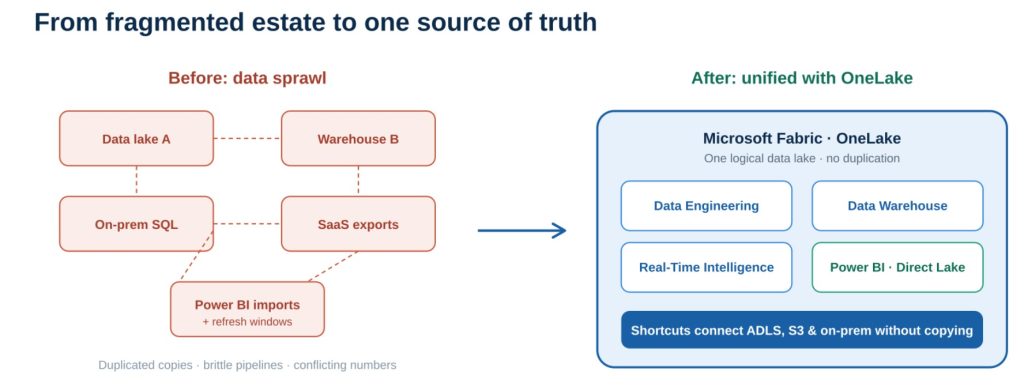
From a fragmented estate of disconnected copies to a single, unified data lake with OneLake.
The change that matters most for IT leaders is what OneLake removes. With OneLake Shortcuts, you can point at data that already lives in Azure Data Lake Storage, Amazon S3, or on-premises systems and use it as if it were in OneLake, without copying it. One logical lake, multiple sources, no duplication. The “pipeline jungle” that exists only to shuffle data from one system into another simply shrinks.
This is not a niche capability. According to Microsoft, the OneLake catalog is already trusted by more than 230,000 organizations worldwide, including 95% of the Fortune 500. The pattern those organizations are adopting is a logical data mesh: domains, sub-domains, and workspaces, each with its own administrator, so ownership stays with the teams that know the data while everyone else can still discover and use it under federated governance.
For a deeper look at how this plays out day to day, our team has written about how Microsoft Fabric unifies data for real-time business decisions and why Microsoft Fabric is the future of data analytics.
Way 2: Lower Cost and Complexity, Not Just Prettier Dashboards
For years, the Microsoft data story was a shopping list of separate products, each licensed, secured, and maintained on its own. Fabric collapses most of that into a single SaaS platform with one storage layer, one security model, and one capacity-based license. Fewer moving parts means a smaller surface area to manage, secure, and pay for.
Two capabilities drive the cost story for IT leaders. The first is the removal of duplication through OneLake, as covered above. The second is Direct Lake mode in Power BI, which queries the Parquet files sitting in OneLake directly, without importing data into a separate model and without the cost of constant refresh windows. You get near-import performance without paying the import-and-refresh tax, which is exactly the kind of operational cost that quietly compounds across hundreds of reports.
Here is how the shift looks in practice:
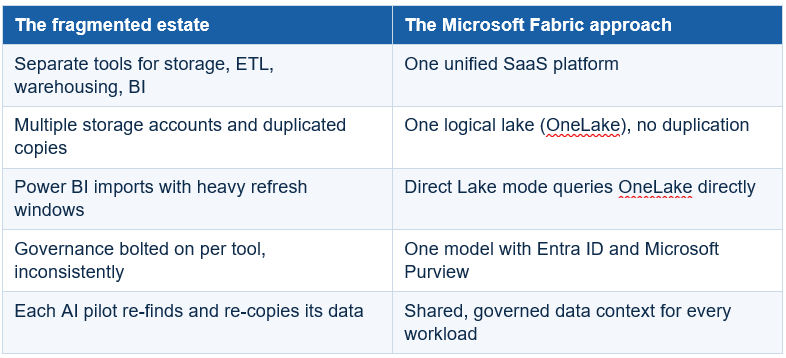
The point is not that dashboards look better. It is that the platform underneath does more with less, freeing IT teams from maintenance work that never showed up on a roadmap but always showed up in the budget. If cost control is a priority this year, it pairs well with the thinking in our guide to optimizing your Microsoft 365, Dynamics, and Azure investments.
Way 3: A Governed Foundation That Makes Data Genuinely AI-Ready
This is the way that matters most in 2026, because it is where most AI strategies quietly fail. The barrier to enterprise AI is rarely the model. It is the data estate. Every new agent or Copilot starts from zero, relearning where data lives and what rules to follow, and without a consistent foundation, agents cannot coordinate or scale.
Fabric closes that gap by making governed data the default, not an afterthought. Security and governance run through Microsoft Entra ID and Microsoft Purview across the whole platform, so sensitivity labels, data loss prevention, and access policies apply consistently rather than being re-implemented per tool. That governed foundation is what turns raw data into something an AI system can safely act on.
On top of it, Fabric adds an intelligence layer. Copilot in Fabric and Copilot for Power BI let analysts explore data and build reports in plain language. And Fabric data agents let business users ask questions in everyday language and get accurate, structured answers, while still respecting the same Microsoft Purview governance controls, data loss prevention, and user permissions that protect the underlying data. In other words, you get the speed of natural-language analytics without giving up control.
The lesson Microsoft itself keeps repeating is worth holding onto: AI does not replace structure, governance, or security. The organizations that win with AI are the ones that get the data foundation right first. That is the same principle behind our Agentic AI Readiness Checklist for 2026.
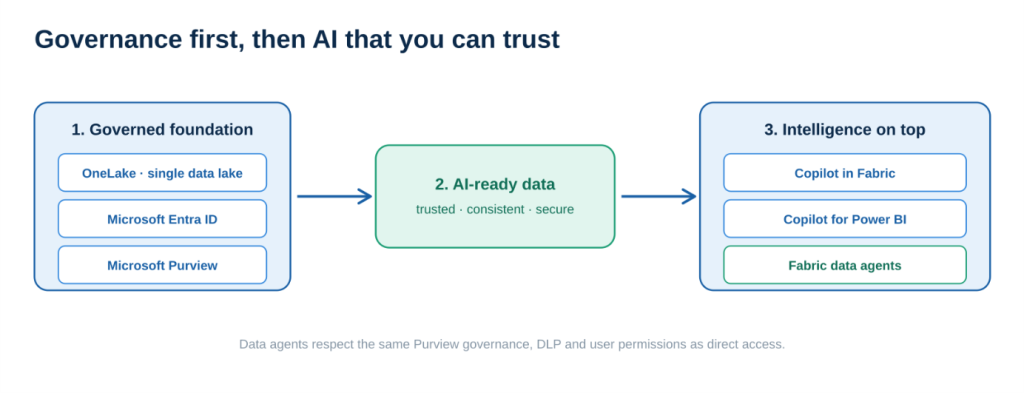
A governed Fabric foundation is what makes Copilot and data agents trustworthy, not just fast.
Where IT Leaders Should Start
The teams that succeed with Microsoft Fabric do not try to migrate everything at once. They treat it as a platform decision and move in stages. A practical first move looks like this:
- Pick one high-value domain. Choose a single business area where fragmented data is causing real pain, such as finance reporting or operations, and bring it into Fabric first.
- Set governance on day one. Configure Entra ID access, Purview sensitivity labels, and workspace ownership before scaling, not after.
- Prove value, then expand. Validate the results with one domain and a clear metric, then extend the logical data mesh across the organization.
This staged approach works best when the underlying environment is stable and well governed, which is exactly where an experienced Microsoft partner earns its place. Cloud 9 Infosystems has spent 16-plus years helping US enterprises modernize their data and AI cloud solutions on the Microsoft platform, across healthcare, financial services, and enterprise IT.
Frequently Asked Questions
What is Microsoft Fabric?
Microsoft Fabric is a unified, software-as-a-service data and analytics platform that brings data engineering, data warehousing, real-time analytics, data science, and Power BI together on one platform, with OneLake as a single underlying storage layer.
What is OneLake in Microsoft Fabric?
OneLake is the single, logical data lake built into every Fabric tenant. It acts as one organization-wide storage layer, so teams can store or connect data once and use it across every Fabric workload without creating duplicate copies.
How does Microsoft Fabric reduce data costs?
Fabric reduces cost by consolidating separate tools into one platform, eliminating duplicated storage through OneLake, and using Direct Lake mode in Power BI to query data directly instead of importing and repeatedly refreshing it.
How does Microsoft Fabric make data AI-ready?
Fabric applies consistent governance through Microsoft Entra ID and Microsoft Purview across the whole platform, then adds Copilot and Fabric data agents on top. This gives AI tools a single, governed source of trusted data to work from, which is the foundation agentic AI needs to scale.
Is Microsoft Fabric secure and governed?
Yes. Security and governance are built in through Microsoft Entra ID for identity and Microsoft Purview for data governance, including sensitivity labels, data loss prevention, and access policies that apply consistently across workloads and to Fabric data agents.
Do we need to migrate everything to Microsoft Fabric at once?
No. The recommended approach is to start with one high-value domain, set governance from day one, prove the value, and then expand the logical data mesh across the organization in stages.
Do we need a partner to adopt Microsoft Fabric?
Not strictly, but a Microsoft partner like Cloud 9 Infosystems helps you design the right data mesh, configure governance correctly from the start, and avoid the cost and security pitfalls that come with rushing a platform migration.
Ready to Turn Data Sprawl Into a Single Source of Truth?
For organizations already invested in Microsoft, Fabric is the logical next step, turning a fragmented data estate into a governed, AI-ready foundation. Cloud 9 Infosystems will help you choose the right first domain, set governance correctly, and build a Fabric strategy that scales.
Recent Posts
Latest Blogs

AI-Assisted Azure Migration: What the Azure Copilot Migration Agent Actually Changes
Microsoft’s AI-assisted Azure migration tools are changing how enterprises discover workloads, map dependencies, plan migration waves, and convert legacy database code—reducing manual effort while keeping critical decisions and validation with human experts.

What Is Generative AI and How Is It Changing Workplace Productivity?
Discover how Generative AI can improve workplace productivity by accelerating content creation, reducing information overload, supporting analysis, and improving communication while balancing human judgment, trusted data, security, governance, and measurable outcomes.

Top Generative AI Use Cases Transforming Industries
Discover the top generative AI use cases transforming healthcare, finance, manufacturing, retail, HR, customer service, IT, and enterprise knowledge management while improving productivity, innovation, customer experiences, and business efficiency.