

Why Most Enterprise AI Stalls, and the 4-Layer System That Fixes It
Your organization probably has a pile of AI wins that never added up to much. A pilot here. An assistant there. A proof of concept that worked well enough to expand, then quietly stalled. If that sounds familiar, the problem is not your models. It is that you bought tools, not a system.
That is the uncomfortable lesson at the centre of Microsoft’s latest thinking on enterprise AI: models alone do not transform a business, the system running them does. A winning enterprise AI strategy is not the company with the most impressive demos. It is the one that turns AI into a governed, continuously improving system for running real work.
This guide breaks that system into four practical layers, the enterprise AI strategy that separates organizations scaling AI from those stuck in pilot purgatory, so you can see what your setup is missing and where to start.
WHAT YOU WILL LEARN
- Why so many enterprise AI projects stall after the pilot
- The four layers every durable enterprise AI system needs
- How each layer maps to a real capability, not a slogan
- A quick self-assessment to see where your gaps are
THE SHORT VERSION
- The trap: most organizations accumulate individual AI tools that each start from scratch, so effort and context never compound.
- The shift: durable enterprise AI is a system, not a collection of demos, that shares context, enforces governance, and gets smarter the longer it runs.
- The four layers: build agents like software, ground them in your business context, run them in production, and govern them with identity, policy, and cost control.
- The multiplier: a continuous learning loop, observe, evaluate, improve, that makes every cycle better than the last.
Why Does Enterprise AI Stall?
The failure pattern is remarkably consistent, and it is rarely about model quality.
Every project starts from zero. Point a new agent at your business and it does not know your customers the way your sales team does, or your definitions of revenue, risk, and success. So each initiative rebuilds the same foundation, and context becomes a scaling problem.
Tools produce individual results; systems compound. A pilot that works in one team does not automatically make the next one easier, because nothing is shared between them, not context, not governance, not the lessons learned.
Governance shows up last, if at all. When agents finally touch real systems and data, security and policy get bolted on after the fact, which is exactly when risk and cost start to spike.
The barrier to enterprise AI is almost never the model. It is the absence of a system around it.
This is the gap the four layers below are designed to close. It is the same foundation-first thinking behind our Agentic AI Readiness Checklist for 2026.
The 4 Layers of a Modern Enterprise AI Strategy
Before we go layer by layer, here is the whole system at a glance. A durable enterprise AI strategy stacks four capabilities, plus a learning loop that spans all of them, so each layer makes the next safer and more valuable.
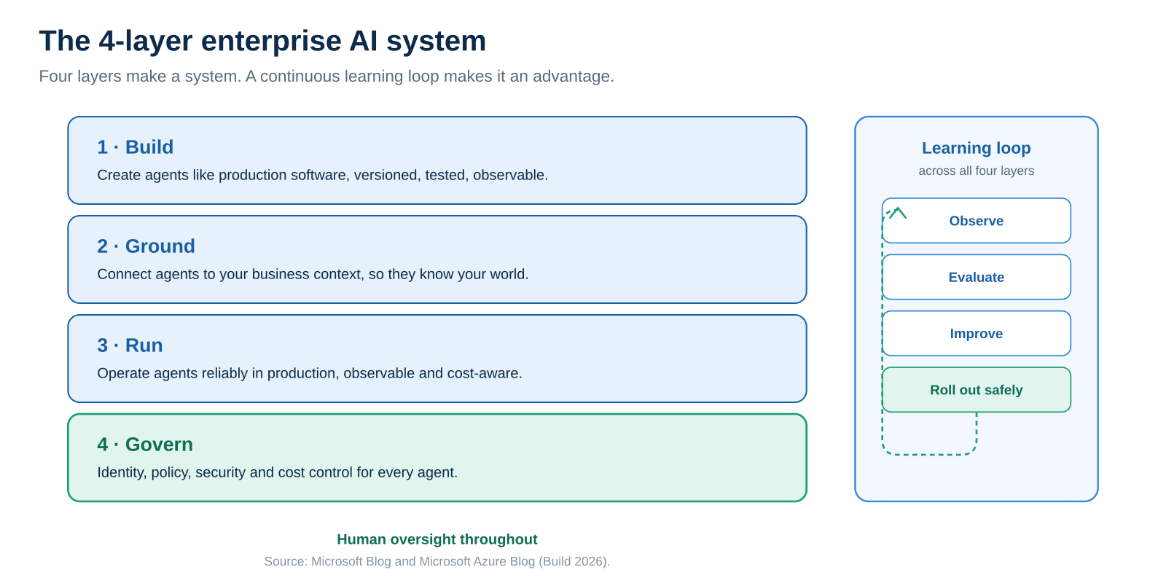
The four layers of an enterprise AI strategy, wrapped by a continuous learning loop.
Each layer answers a different question: how agents are built, how they are grounded in your context, how they are run in production, and how they are governed. Miss one, and the system leaks value at that seam.
Layer 1: Build, Treat Agents Like Production Software
The first layer is how agents are created. The organizations that scale enterprise AI stopped treating agents as clever prompts and started treating them as software.
That means agents are versioned, tested, and observable, just like any production code. You bring together the assets that matter, the codebases, work items, skills, and tools, and you keep evaluations and observability alongside them, so quality is measurable, not a matter of hope.
The payoff is repeatability. When an agent is built like software, you can improve it deliberately, roll it back if needed, and reuse what works, instead of rebuilding from scratch each time. This is the discipline behind our work on agentic AI digital workers for enterprises.
Layer 2: Ground, Give AI Your Context, Not Just a Model
The second layer is the one most organization skip, and it is the most decisive. A capable model with no knowledge of your business is a generic tool. A model grounded in your context is a competitive advantage.
Context is what makes AI know your world, not just the world. Grounding agents in your real business data, across Microsoft 365, your core systems, your knowledge bases, means they reach accurate answers instead of guessing or hallucinating.
But access alone is not grounding. Pointing AI at raw information is brittle. The data has to be organized, secured, and surfaced in a form agents can actually use, which is why a strong data foundation, like the one we describe in Microsoft Fabric for data and analytics, matters so much. As Microsoft’s leadership puts it, you should be able to swap one model for another without losing the institutional knowledge you have built, and that is only possible when your context lives in your system, not the model.
Layer 3: Run, Move from Prototype to Production
The third layer is where most pilots die: the gap between a promising proof of concept and something the business can actually run at scale.
Production is a different discipline than experimentation. Running agents at scale means handling long-running, multi-step work reliably, integrating with core systems, and modernizing those systems continuously rather than through disruptive, once-a-year overhauls.
Operating agents also means seeing them. You cannot run in production what you cannot observe, which is why monitoring and root-cause visibility are part of this layer, the subject of our guide to agentic observability for Azure cloud operations. And because production work consumes real compute, this is where Microsoft AI cost management becomes a first-class concern.
Layer 4: Govern, Make Trust Part of the System
The fourth layer is what makes the other three safe to scale. As more agents move into production, governance and security cannot be an afterthought, they have to be built in from the start.
Every agent needs identity, policy, and oversight. That means a single place to see every agent in your organization, who deployed it, what data and tools it can access, how it is behaving, and what it costs, with the ability to enforce policy or intervene when needed.
Trust is a structural property, not a promise. When identity, data governance, and security are part of the platform, human oversight stays central and agents operate within boundaries you define. This is the territory we cover in AI agent security and Zero Trust and secure enterprise AI in 2026, and it now extends to everyday surfaces like Microsoft Teams bot protection.
Not sure which layers your enterprise AI strategy is missing?
In a free 30-minute consultation, Cloud 9 Infosystems will assess your current AI setup against all four layers, pinpoint the gaps holding you back, and map a practical path to a system that scales.
The Learning Loop That Ties It Together
Four layers make a system, but one thing turns that system into an advantage: a continuous learning loop, the engine behind real return on your AI investment.
Every agent action generates signal. Trajectories, outcomes, feedback. A mature enterprise AI strategy captures that signal, evaluates it, improves the agent, and rolls the change out safely, then repeats, continuously, in production.
This is why systems pull ahead of tools. A pile of disconnected tools stays exactly as good as the day you deployed it. A system that observes, evaluates, and improves gets better every quarter, and the gap between the two widens over time.
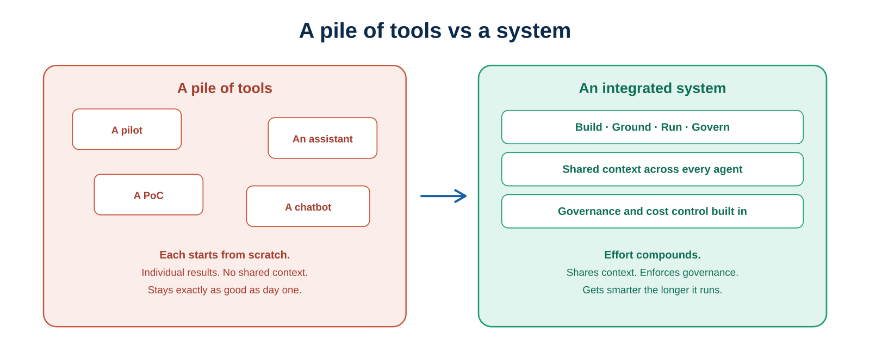
Individual tools produce individual results. A system shares context, enforces governance, and compounds.
Is Your Enterprise AI a System or a Pile of Tools?
Use this quick check. The more you answer “no,” the more your enterprise AI strategy is a collection of demos rather than a system.
- Build: Are your agents versioned, tested, and observable like production software?
- Ground: Do your agents draw on governed business context, or start from scratch each time?
- Run: Can you reliably move agents from proof of concept to production, and see how they behave?
- Govern: Do you have one place to see, secure, and control every agent and its cost?
- Learn: Does your system capture signal and improve continuously, or stay static?
If the honest answers reveal gaps, that is not a failure, it is a roadmap. This is exactly the kind of assessment an experienced Microsoft partner can run with you. Cloud 9 Infosystems has spent 16-plus years helping US enterprises turn scattered AI efforts into governed, production-grade systems across healthcare, financial services, and enterprise IT, backed by our data and AI cloud solutions.
The Bottom Line for IT Leaders
The next era of enterprise AI will not be won by the organizations with the flashiest models. It will be won by the ones with an enterprise AI strategy built as a system, agents created like software, grounded in real context, run in production, and governed with identity and cost control, that gets smarter every cycle.
Models will keep getting cheaper and more interchangeable. Your context, your governance, and your operating discipline are what compound. A real enterprise AI strategy makes the model a detail. Skip it, and even the best model will stall after the pilot.
Microsoft Resources Referenced in This Article
- AI alone won’t change your business. The system running it will. (Microsoft Blog)
- 3 things leaders need to know from Microsoft Build 2026 (Microsoft Azure Blog)
- Microsoft Build 2026 news (Microsoft)
Frequently Asked Questions
Why do so many enterprise AI projects fail or stall?
Most enterprise AI stalls not because of weak models, but because organizations deploy individual tools instead of a system. Each project starts from scratch without shared context, governance is added late, and nothing compounds. Building a system, where agents are grounded in context, run in production, and governed centrally, is what turns pilots into durable results.
What are the layers of an enterprise AI system?
A durable enterprise AI system has four layers: build (create agents like production software), ground (connect agents to your real business context), run (operate agents reliably in production), and govern (manage identity, policy, security, and cost). A continuous learning loop across all four makes the system improve over time.
Why is context so important for enterprise AI?
A capable model with no knowledge of your business is a generic tool. Grounding agents in your organization’s data, definitions, and processes is what lets them produce accurate, relevant results, and it means you can change models without losing the institutional knowledge you have built.
What does AI governance mean in practice?
In practice, AI governance means every agent has an identity, operates under defined policies and access controls, and is visible in one place, so IT can see who deployed it, what it can access, how it behaves, and what it costs, and can intervene when needed. It keeps human oversight central as agents scale.
How do we start building an enterprise AI system instead of buying more tools?
Start by assessing your current AI against the four layers, build, ground, run, and govern, to find the biggest gaps. Prioritize a strong, governed data foundation and central governance early, then scale deliberately. A readiness assessment with a Microsoft partner can map your specific starting point.
Does an enterprise AI system lock us into one AI model?
No. A well-designed system does the opposite. When your context and governance live in your platform rather than in a single model, you can swap models as they improve or as pricing changes, without losing your institutional knowledge or rebuilding your foundation.
Ready to Turn Scattered AI Into a System That Scales?
The difference between AI that stalls and AI that compounds is the system around it. Cloud 9 Infosystems will assess your enterprise AI across all four layers, identify the gaps, and help you build a governed, production-grade foundation on the Microsoft platform.
Recent Posts

Why Most Enterprise AI Stalls, and the 4-Layer System That Fixes It
Discover why most enterprise AI initiatives stall after pilot projects and learn the proven four-layer strategy for building scalable AI systems. Explore governance, context, production readiness, and continuous improvement to achieve lasting AI success.

Microsoft Teams Bot Protection: Who’s Really in Your Meeting?
Discover how Microsoft Teams Bot Protection helps prevent unauthorized AI meeting bots from joining sensitive calls. Learn how lobby controls, bot detection, governance, and Zero Trust policies protect your Microsoft 365 meetings and enterprise data.

Agentic Observability: What It Means for Your Azure Cloud Operations in 2026
Discover how Agentic Observability uses AI to transform Azure cloud operations with faster root cause analysis, intelligent monitoring, and secure governance. Learn how Azure Copilot Observability Agent helps IT teams reduce downtime and improve operational efficiency.

Join Us on the Journey to Transforming Futures - Contact Us!
Schedule a meeting with our experts or fill out the form for a free assessment of your environment today!


*Cloud 9 reserves the right for free assessment eligibility.