

Agentic AI vs Traditional Automation: What’s the Difference?
Automation Is Evolving And So Is the Way Businesses Compete
For years, organizations across Chicago, Illinois, and the broader USA have leaned on automation to stay competitive: robotic process automation (RPA), workflow engines, and chatbots have streamlined repetitive tasks, cut manual effort and brought consistency to everyday operations. That’s not changing but what’s being built on top of it is.
A new category of intelligent systems is rewriting the playbook: Agentic AI.
Traditional automation follows predefined rules and workflows. AI agents reason, plan, use tools, access knowledge sources and adapt their actions based on business goals and context. Microsoft positions agents as systems that go beyond generating responses; they interpret intent, plan work and take action on behalf of users.
The real question facing business leaders today isn’t whether automation adds value. It’s whether the automation you already have is built to keep up with increasingly complex, judgment-driven business processes or whether it’s time to move from automating tasks to empowering outcomes.
What Is Traditional Automation?
Traditional automation focuses on executing predefined instructions and it still earns its place in the enterprise stack. Common examples include:
- RPA bots processing invoices
- Workflow approvals
- Scheduled data transfers
- Rule-based customer service workflows
- Scripted chatbot interactions
These systems excel when processes are predictable and structured. But they hit a ceiling fast when faced with ambiguity, changing requirements or unstructured data because traditional automation requires human designers to map out every possible decision path before it ever goes live. One exception, one edge case and the workflow breaks.
What Is Agentic AI?
Agentic AI flips the model from fixed instructions to goal-oriented reasoning.
According to Microsoft’s agent ecosystem guidance, agents can interpret intent, plan work, interact with tools and execute actions to achieve objectives. They’re built to participate in workflows not just respond to them.
Microsoft Foundry Agent Service describes AI agents as managed systems capable of handling conversations, tool calls, orchestration and agent lifecycle management, all while integrating with enterprise security and governance controls.
In practical terms, an AI agent can:
- Access multiple business systems
- Retrieve information from enterprise knowledge bases
- Make contextual decisions
- Trigger workflows
- Escalate issues when required
- Collaborate with humans
Instead of following one fixed path, the agent determines the most appropriate next action based on the information and objectives in front of it closer to a capable team member than a script.
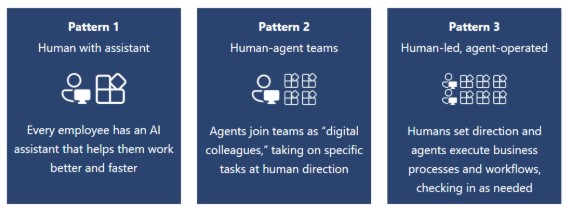
AI maturity starts at simple AI assistance, then progresses to more complex patterns between humans and agents.
Agentic AI vs Traditional Automation: The Side-by-Side
Traditional Automation | Agentic AI |
Rule-based execution | Goal-based execution |
Fixed workflows | Dynamic planning and reasoning |
Limited adaptability | Context-aware decision making |
Handles structured tasks | Handles structured and semi-structured tasks |
Requires predefined paths | Determines next steps dynamically |
Minimal understanding of intent | Interprets user intent and business context |
This isn’t a story about replacement. It’s a story about evolution: the shift from process automation toward intelligent automation and autonomous workflow execution.
Where Do Chatbots and Copilots Fit In?
Here’s where most of the confusion in the market comes from: many organizations assume AI agents are just “smarter chatbots.” They’re not and knowing the difference determines what technology actually solves your problem.
Chatbots primarily answer questions and follow predefined conversation paths.
Copilots assist users by providing recommendations, content generation and productivity support, a partner that helps a person do their job faster.
AI Agents can perform tasks, invoke tools, execute workflows, monitor events and pursue goals with defined guardrails and governance controls. Microsoft Copilot Studio specifically describes autonomous agents as systems that can perceive events, make decisions and execute tasks independently while operating within defined permissions and guardrails.
In short: chatbots talk, Copilots assist and agents act.
Real-World Enterprise Examples

IT Service Management
Traditional Automation: Creates tickets from predefined triggers.
Agentic AI: Reviews incident details, searches knowledge repositories, suggests remediation, escalates when required and creates documentation automatically.
HR Operations
Traditional Automation: Sends onboarding checklists.
Agentic AI: Coordinates onboarding activities, answers policy questions, triggers approvals, schedules meetings and tracks completion status.
Finance
Traditional Automation: Generates scheduled reports.
Agentic AI: Collects data from multiple systems, identifies anomalies, creates summaries and escalates exceptions for review.
Building Enterprise AI Agents on Microsoft Azure
Microsoft provides a full stack of services purpose-built to support enterprise-grade AI agents and this is where a well-planned Agentic AI strategy starts paying off.
Microsoft Foundry serves as Microsoft’s AI application and agent platform, enabling organizations to build, optimize and govern AI applications and agents at scale.
Foundry Agent Service provides orchestration, security, scaling, identity management, tool integrations and governance capabilities for enterprise AI agents.
Microsoft Copilot Studio allows organizations to build AI-powered agents and workflows that connect to business data, systems and processes using a low-code approach, putting agent-building within reach of business and IT teams alike.
Power Platform extends agent capabilities across business applications and workflow automation environments, connecting agentic AI to the tools your teams already use.
Governance Matters as Much as Automation
Speed and intelligence mean little without control. As organizations move beyond simple automation, governance becomes just as important as the automation itself.
Microsoft recommends keeping autonomous agents within clearly defined scopes, permissions, guardrails and auditable processes. Human oversight remains critical for high-impact business decisions which is why agentic doesn’t mean unsupervised.
A successful Agentic AI strategy should include:
- Security controls
- Access management
- Compliance requirements
- Human approval workflows
- Monitoring and observability
- Responsible AI practices
How Cloud 9 Can Help
Based in Chicago, Illinois, Cloud 9 Infosystems helps organizations across the USA move from traditional automation to intelligent, AI-powered operations with the Microsoft expertise to do it right the first time. Our team works hands-on with:
- Microsoft Foundry implementation
- Copilot Studio agent development
- Power Platform automation
- AI governance frameworks
- Managed AI services
- Azure modernization programs
Whether you’re a growing business in Chicago or an enterprise team anywhere in Illinois or across the USA, exploring AI agents for internal operations, customer service, HR, finance or IT support, our specialists can help you identify exactly where agentic automation delivers measurable business value, without the guesswork.
Conclusion: The Future Is Automation Plus Reasoning
Traditional automation remains effective for repetitive, predictable processes and it isn’t going anywhere. But organizations looking to automate more complex, judgment-driven workflows are increasingly exploring Agentic AI as the next step forward.
The future isn’t about replacing automation. It’s about combining automation with reasoning, context, and intelligent decision-making.
Organizations that understand the difference today whether headquartered in Chicago, expanding across Illinois, or scaling nationwide across the USA, will be better positioned to build scalable, secure, and governed AI-powered operations tomorrow.
Ready to see where Agentic AI fits in your business?
Recent Posts

Agentic AI vs Traditional Automation: What’s the Difference?
Discover Microsoft Cloud Managed Services for Azure and Microsoft 365. Learn how managed services improve cloud security, governance, cost control, monitoring, backup, disaster recovery, and IT support while extending your internal team.
What Are Microsoft Cloud Managed Services?
Discover Microsoft Cloud Managed Services for Azure and Microsoft 365. Learn how managed services improve cloud security, governance, cost control, monitoring, backup, disaster recovery, and IT support while extending your internal team.
Microsoft 365 Copilot July 2026 Updates: New AI Models, Smarter Workflows and Enterprise Automation
Explore the Microsoft 365 Copilot July 2026 updates, including GPT-5.6, Copilot Cowork automation, Power BI integration, Teams Meeting Recaps, Copilot Connectors, and enhanced governance designed to boost enterprise productivity and AI adoption.

Join Us on the Journey to Transforming Futures - Contact Us!
Schedule a meeting with our experts or fill out the form for a free assessment of your environment today!


*Cloud 9 reserves the right for free assessment eligibility.