

AI for Small Businesses in Chicago: Why You’re Already Ahead, and How to Stay There
Whether you’re running a logistics company near Midway, a professional services firm in the Loop, a manufacturer in the western suburbs, or a growing team anywhere else in Illinois, you probably do not have a task force. You do not have a twelve-month transformation roadmap or a committee that meets on Thursdays to discuss AI strategy. What you have is a Tuesday afternoon, a process that is slowing you down, and the freedom to just fix it.
According to Microsoft, that is turning into a real advantage. Small and medium businesses are adopting AI faster and more effectively than large enterprises, not despite having fewer resources, but in some ways because of it. Here is what is driving that shift, what it looks like in practice, and how Chicago-area and Illinois small businesses can move fast without leaving their business exposed.
WHAT YOU WILL LEARN
- Why SMBs are outpacing enterprises on practical AI adoption
- Real results from real small and mid-sized businesses using AI today
- Why security has to be part of the plan from day one, not bolted on later
- A simple way to start, without a big budget or a long rollout
THE SHORT VERSION
- SMBs make up 90% of businesses worldwide, 50% of global GDP, and 70% of the global workforce, and they are moving on AI faster than larger organizations.
- Real businesses are already seeing dramatic results: a 90% cut in research time, a 70% efficiency gain in customer interactions, and a 60% drop in administrative overhead.
- The businesses pulling ahead are not just adopting AI earlier, they are building it into daily workflows, not just individual tasks.
- Security cannot be an afterthought. AI adoption and cybersecurity are directly connected, and the businesses moving fastest are solving both together.
Why Small Businesses Are Actually Ahead on AI
It sounds backwards. Enterprises have bigger budgets, dedicated IT teams, and data science departments. Small businesses have none of that. And yet, according to Microsoft’s research, SMBs are turning AI into a competitive advantage faster than most large organizations can move.
The math on why this matter is hard to ignore. SMBs represent roughly 90% of all businesses worldwide, half of global GDP, and 70% of the global workforce. When this segment moves, the ripple effect is enormous, and Chicago and Illinois, with an economy built on manufacturing, logistics, professional services, and healthcare, are exactly the kind of diverse small-business base where that shift plays out.
They also cannot afford to get it wrong. The median small business carries only about 27 days of cash reserves, so there is no room to bet on the wrong transformation. That pressure, paradoxically, is part of why SMBs move with more focus than larger organizations weighed down by longer decision cycles.
And the underlying data backs up the shift. Microsoft’s 2026 Work Trend Index found that 58% of AI users are already producing work they could not have done a year ago, and 66% report spending more time on higher-value work as AI takes on routine execution. In a five-person team, whether that team is downtown or out in DuPage County, that is not a marginal improvement. It is a structural advantage.
What Frontier Transformation Looks Like for a Small Business
Microsoft calls the businesses making this shift real “Frontier Firms,” organizations that move beyond individual AI use into repeatable, team-wide workflows. The results from real businesses make the case better than any statistic.
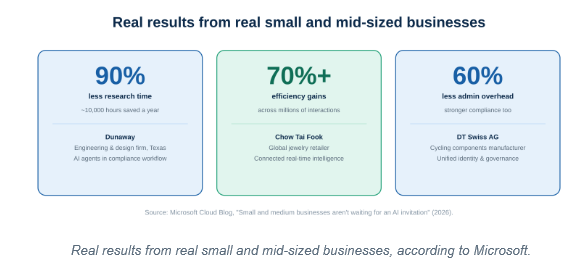
A Texas engineering firm turned a bottleneck into a real-time workflow. At Dunaway, a multi-discipline design, planning, and engineering firm, regulatory research and compliance checks used to be slow, manual steps that delayed every project. By putting AI agents into that workflow, engineers now get regulatory answers in real time. The result: a 90% reduction in research time and roughly 10,000 hours saved every year, work that once depended on a few experts, now available to the whole team. The same pattern applies directly to Illinois firms navigating municipal, county, and state regulatory requirements across multiple jurisdictions.
A luxury retailer scaled personal service without losing the personal touch. Chow Tai Fook, a long-running jewellery brand with thousands of stores, connected its previously isolated digital tools into one real-time intelligence model, giving store associates the insight they need in the moment. The result was more than 70% efficiency gains across millions of monthly customer interactions, a lesson just as relevant for Chicago’s retail and hospitality businesses balancing personal service with scale.
A manufacturer made security the foundation, not a separate task. DT Swiss, a Swiss manufacturer with teams across three continents, unified identity, access, and governance into daily operations instead of treating them as extra layers of work. The result was a 60% reduction in administrative overhead and a stronger compliance position, proof that security does not have to slow a business down, a message that resonates with Illinois’ deep manufacturing base.
The pattern across all three: these businesses did not just adopt AI earlier. They moved from isolated use cases to integrated workflows, and from treating security as a separate control to building it in as the foundation for growth.
Why Security Has to Come First, Not Last
This is the part that gets skipped when businesses move fast, and it is the part Microsoft is explicit about: AI adoption and security are directly connected, not two separate decisions.
The risk is real and it is expensive. In a 2024 Microsoft Security study, one in three SMBs had been hit by a cyberattack in the past year, at an average cost of over $254,000. Ninety-four percent consider cybersecurity critical to their business, and 81% say AI increases the need for stronger controls, not less.
Small businesses cannot afford five separate decisions for one outcome. You do not have the time or the team to solve productivity, data protection, identity, and compliance as five different projects. The businesses moving fastest are solving them together, with security built into the foundation from the start, not added after something goes wrong.
Not sure where AI and security overlap for your business?
In a free 30-minute consultation, Cloud 9 Infosystems, headquartered in Downers Grove in the Chicago area and serving small and medium businesses across Illinois, will look at your current setup, identify the one workflow worth transforming first, and make sure security is built in from day one, not bolted on later.
How to Start, Without a Six-Figure Budget
The businesses in Microsoft’s research did not start with a grand transformation plan. They started with one visible problem and solved it.
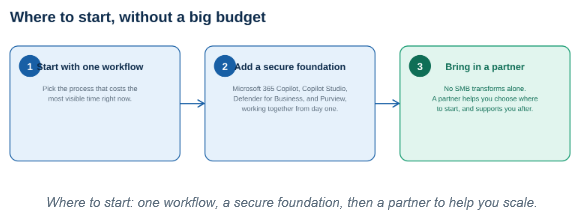
Start where the time cost is most visible. Pick the one process that everyone complains about, research that takes too long, document prep that eats a whole afternoon, admin work that pulls you away from customers, and start there.
Build in a secure foundation from day one. Productivity tools like Microsoft 365 Copilot are the common starting point, then workflows extend with tools like Microsoft Copilot Studio, with security layered in through tools built for smaller teams, like Microsoft Defender for Business and Microsoft Purview.
Bring in a partner before you need one. Microsoft’s own guidance is direct: no SMB transforms alone. The businesses in these examples all had a partner helping them decide where to start, how to fold AI into real workflows, and how to support the team after rollout, not just at launch.
You do not need a grand plan. You need a first process, a secure foundation, and the decision to act. This is exactly where a local Microsoft partner earns its place. Cloud 9 Infosystems, headquartered in Downers Grove, helps growing businesses across the Chicago area and throughout Illinois put Microsoft 365 Copilot, Copilot Studio, and Microsoft’s security tools to work together from day one, so speed and safety are never a trade-off.
The Bottom Line for Illinois Small Business Leaders
The AI era will not be defined by company size or by zip code. It will be defined by how deliberately a business moves. Fewer layers of decision-making, tighter budgets, and real day-to-day pressure are turning out to be an advantage, not a limitation, for the businesses willing to act, whether that business is in the Loop, the collar counties, or downstate.
The businesses pulling ahead are not the ones with the biggest budget. They are the ones who picked one real problem, built security in from the start, and brought in the right local help to move faster than they could have alone.
Microsoft Resources Referenced in This Article
- Small and medium businesses aren’t waiting for an AI invitation, they’re already leading (Microsoft Cloud Blog)
- Microsoft Work Trend Index 2026 (Microsoft WorkLab)
Frequently Asked Questions
Why are small and medium businesses adopting AI faster than enterprises?
According to Microsoft, SMBs have leaner structures and shorter decision cycles, so they can embed AI into real workflows faster than large enterprises weighed down by longer approval processes. Microsoft’s 2026 Work Trend Index found 58% of AI users are already producing work they could not a year ago, and 66% are spending more time on higher-value work as AI takes on routine tasks.
What results are small businesses actually seeing from AI?
Real examples from Microsoft’s research include a 90% reduction in research time and about 10,000 hours saved annually at an engineering firm, more than 70% efficiency gains across customer interactions at a retail brand, and a 60% reduction in administrative overhead at a manufacturer that unified its security and identity processes.
Do small businesses need to worry about AI security?
Yes, and Microsoft is explicit that AI adoption and security are directly connected. A 2024 Microsoft study found one in three SMBs had been hit by a cyberattack in the past year at an average cost of over $254,000, and 81% of SMBs say AI increases the need for stronger security controls, not less.
How should a small business start with AI?
Start with a single, visible problem, such as slow research, manual document prep, or repetitive admin work, rather than a large transformation plan. Layer in a secure foundation from the beginning using tools built for small teams, and work with a partner who can help you choose where to start and support you after rollout.
What Microsoft tools are common starting points for SMBs?
Many small businesses start with Microsoft 365 Copilot for everyday productivity, then extend into custom workflows with Microsoft Copilot Studio, while adding security through tools like Microsoft Defender for Business and Microsoft Purview, all built to work together rather than as separate decisions.
Does Cloud 9 Infosystems work with small businesses outside of Chicago?
Yes. Cloud 9 Infosystems is headquartered in Downers Grove, in the Chicago area, and works with small and medium businesses across Illinois, as well as clients nationwide, bringing the same Microsoft AI and security expertise to teams wherever they are based.
Ready to Turn One Workflow into Your First AI Win?
You do not need a big budget or a long rollout plan to get started. Cloud 9 Infosystems, headquartered in Downers Grove, will help Illinois small and medium businesses find the right first workflow, build in the right security from day one, and put Microsoft’s AI tools to work safely and quickly.
Recent Posts

30 Million Microsoft 365 Copilot Seats Later: Is Your Copilot License Paying Off?
Microsoft 365 Copilot has reached 30 million paid seats, but licenses alone do not guarantee value. Learn how to measure adoption, track ROI, optimize usage, and right-size Copilot licensing before your next renewal.

Measuring Generative AI ROI: A Practical Framework for 2026
Learn how to measure Generative AI ROI with a practical 2026 framework. Connect AI costs to business outcomes, track value, manage governance, and build a defensible case for scaling AI investments.

Azure Virtual Desktop Hybrid Is Now Generally Available. Here Is What Changes.
Azure Virtual Desktop Hybrid lets organizations keep session hosts on-premises while using Azure for management and brokering. Learn how Azure Arc, outbound HTTPS and a no-VPN model simplify hybrid desktop deployments.

Join Us on the Journey to Transforming Futures - Contact Us!
Schedule a meeting with our experts or fill out the form for a free assessment of your environment today!


*Cloud 9 reserves the right for free assessment eligibility.