

Project Perception: What Microsoft’s New Agentic Security Stack Means for Your SOC
Your security operations Center (SOC) is still fighting yesterday’s war with yesterday’s tools. Attackers, meanwhile, are already using AI to generate exploits faster, scale campaigns wider, and operate around the clock. Microsoft’s answer, announced this week, is agentic security: a system that can perceive, reason, and act at the same machine speed as the threats it is defending against.
Microsoft calls it Project Perception, and it enters public preview on August 3, 2026. Here is what it actually does for your SOC, how the pieces fit together, and what your team should do to get ready.
WHAT YOU WILL LEARN
- Why traditional SOC tooling cannot keep pace with AI-speed attacks
- How Project Perception’s three agent classes work together
- What the underlying Cyber Stack is made of, layer by layer
- The real business benefits for your SOC, beyond the technology itself
- How to prepare your environment before or during public preview
THE SHORT VERSION
- Microsoft has introduced Project Perception, an agentic security system built to defend against AI-speed attacks, entering public preview on August 3, 2026.
- It coordinates three classes of agents, red team, blue team, and green team, into a closed loop that continuously finds risk, evaluates it, and fixes it.
- It runs on a multi-model architecture that matches the right model to each security task, which Microsoft says cuts cost by roughly half in its first deployed scenario while improving accuracy.
- It is built on Microsoft’s Responsible AI principles and inherits the governance, compliance, and operational controls organizations already rely on, keeping humans firmly in control.
Why Security Needs to Move at Machine Speed
The threat landscape has changed in a way most SOC tooling was never built for.
Attackers are moving faster because AI lets them. Autonomous tools can generate exploits, scale campaigns, and operate continuously, lowering the cost of offense even as the volume and complexity of what defenders must protect keeps growing.
Human-speed defense cannot keep pace with machine-speed attacks. The tools built for a world where a SOC analyst triages every alert by hand are structurally too slow for a world where an adversary’s tooling never sleeps.
More alerts is not the answer. Microsoft’s own framing is direct: the next generation of security systems will not be judged by how many alerts they generate, but by whether they can continuously perceive, reason, and act, a distinction any SOC team drowning in alert queues will recognize immediately.
Security stopped being a staffing problem a while ago. It is now a speed problem, and speed requires a different kind of system.
This is the same pressure we have covered in our guide to agentic observability for Azure cloud operations, where the same machine-speed gap shows up in incident response. Project Perception is Microsoft’s answer for the security side of that same coin.
What Is Project Perception?
Project Perception is Microsoft’s new agentic security system, purpose-built to defend against AI-driven threats using AI of its own. It brings together signals, context, models, and specialized agents into what Microsoft describes as a continuously learning system of defense, designed to operate alongside, not instead of, your SOC.
The design principle behind it is straightforward: effective defense requires an ongoing understanding of how an attacker sees your environment, how a defender should weigh real risk, and how protections improve over time. Project Perception is built to hold all three of those views at once, continuously, rather than treating them as separate, occasional exercises.
How Project Perception Actually Works
At the Center of the system are three coordinated classes of specialized agents, each with a distinct job, working together in a closed loop.
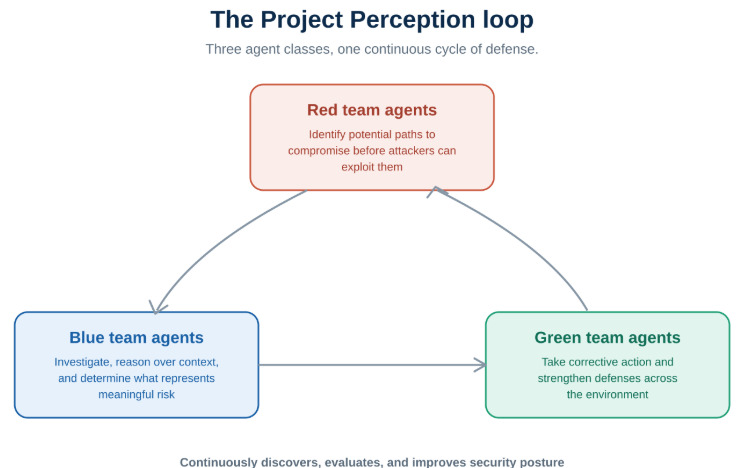
The Project Perception loop: red team agents find the risk, blue team agents assess it, green team agents fix it, continuously.
Red team agents find the paths attackers would take. They probe your environment for potential routes to compromise before a real attacker can exploit them, effectively running offense against your own systems on an ongoing basis.
Blue team agents investigate and reason over what actually matters. They take the paths red team agents’ surface, evaluate the surrounding context, and determine which risks are meaningful enough to act on, cutting through noise rather than adding to it.
Green team agents take the corrective action. Once a risk is confirmed, green team agents make the fix and strengthen the relevant defences across the environment, closing the loop.
Working together, these three agent classes continuously discover, evaluate, and improve an organization’s security posture, rather than waiting for a scheduled audit or a human analyst to notice a gap.
Traditional SOC vs. Agentic Security: A Direct Comparison
The shift Project Perception represents is easiest to see side by side. Here is how a traditional, human-paced SOC compares to a SOC running agentic security.
Traditional SOC | SOC with Agentic Security (Project Perception) |
Analysts triage alerts manually, one at a time | Agents continuously perceive risk across the entire environment |
Vulnerability scans and audits run on a schedule | Red team agents probe for compromise paths continuously |
Context is reassembled by hand for every incident | Security context is pre-built and token-efficient for agents to use |
One general-purpose tool or model for every task | A multi-model architecture matches the best model to each task |
Fixes happen after human review and approval queues | Green team agents apply corrective action as risk is confirmed |
Response time measured in hours or days | Response time measured in the same speed as the attack itself |
Coverage depends on analyst headcount and shift coverage | Coverage is continuous, 24/7, regardless of staffing |
The pattern across every row is the same: a traditional SOC reacts in cycles, while agentic security closes the loop continuously. That does not remove the SOC, it changes what the SOC spends its time on.
The Business Benefits for Your SOC, Beyond the Technology
It is easy to get lost in the technical architecture and miss why this matters commercially. For a SOC leader building the case internally, the benefits break down into four concrete categories.
Faster mean time to respond. When red, blue, and green team agents operate continuously instead of in scheduled cycles, the gap between a risk emerging and a risk being closed shrinks from days to something closer to real time.
Lower cost per task, not just lower headcount. Microsoft’s own benchmark for the first deployed scenario showed roughly 50% cost savings using a matched, specialized model instead of a single general-purpose one. That is a cost efficiency gain your SOC keeps whether or not you change your staffing model.
Analysts spent on judgment, not triage. Offloading the repetitive discovery-and-triage cycle to agents frees your most experienced SOC staff for the decisions that actually need human judgment: scoping an incident, communicating with leadership, and making the calls agents are not meant to make alone.
Consistent coverage regardless of staffing gaps. A SOC’s weakest moment is often nights, weekends, and holidays when staffing thins. Agentic security does not take a shift off, which closes a coverage gap every SOC has lived with.
Together, these are the numbers and outcomes that turn “interesting technology” into a business case a CFO will actually sign off on.
The Cyber Stack Underneath It
Project Perception is not a single agent bolted onto existing tools. Microsoft built it as a new, layered stack designed specifically for agentic security.
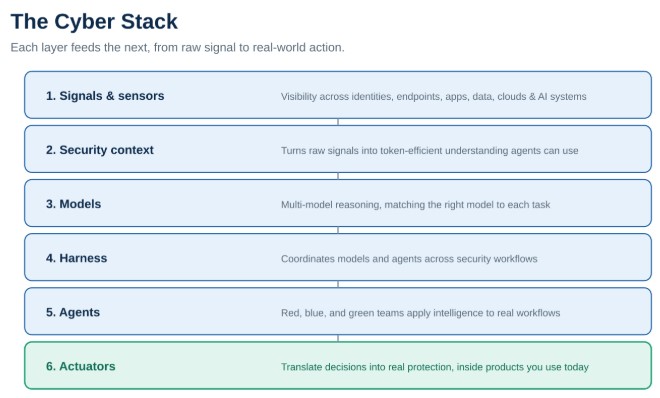
The Cyber Stack: each layer feeds the next, from raw signal to real-world action.
Signals and sensors provide the raw awareness. This is the visibility layer, spanning identities, endpoints, applications, data, clouds, and AI systems themselves.
Security context turns raw signals into something agents can actually use. Rather than forcing every agent to reconstruct context from scratch, Microsoft transforms its visibility and threat intelligence into a continuously updated, token-efficient picture of an organization’s assets, identities, relationships, risks, and activity. This is the same principle behind grounding we cover in our Enterprise AI Strategy 4-Layer System: agents are only as good as the context they are given.
Models provide the reasoning, and no single model does every job well. Project Perception uses a multi-model architecture that matches the right model to each security task based on quality, reliability, latency, and cost, rather than routing everything through one general-purpose model. In its first deployed scenario, software vulnerability management, Microsoft’s specialized MAI-Cyber-1-Flash model inside its MDASH system scored 96% on the CyberGym benchmark, a leading industry measure, while cutting cost by roughly half compared to the prior configuration.
A harness coordinates models and agents across workflows, and actuators turn decisions into real action inside the security products organizations already use. Microsoft is explicit that security teams do not need more information, they need better outcomes, which is why the ability to act, not just observe, is built into the stack itself.
Wondering how agentic security fits into your environment?
In a free 30-minute consultation, Cloud 9 Infosystems will assess your current security stack, map where agentic capabilities like Project Perception can reduce risk and response time and help you prepare for public preview.
Why Governance Comes Built In, Not Bolted On
An autonomous system that can take action across your environment only earns trust if it operates inside real guardrails.
Microsoft states that Project Perception is built in alignment with its Responsible AI principles and inherits the same security, compliance, governance, and operational controls organizations already rely on today. Humans stay firmly in control, with agents amplifying what defenders can do rather than replacing their judgment.
This is consistent with the governance-first approach we have covered across our security content, from AI agent security and Zero Trust to how Microsoft Teams now governs AI meeting bots. The pattern is consistent: as Microsoft gives agents more autonomy, it pairs that autonomy with more explicit, structural control, not less.
How to Prepare Your SOC for Project Perception
Public preview opens August 3, 2026, which gives SOC teams a narrow but real window to get ready. A sensible starting point looks like this:
- Take stock of your current visibility. Project Perception’s value depends on the breadth of signal it can see. Identify the gaps in your current coverage across identities, endpoints, applications, data, and cloud environments now.
- Review your existing Microsoft security stack. Since Project Perception is deeply integrated across Microsoft Security products, the value you get depends on how much of that stack, including tools like Microsoft Sentinel and Microsoft Security Copilot, is already in place.
- Clarify your governance model before autonomy expands. Confirm who can approve automated actions, what gets logged, and how exceptions are handled, so agentic response fits inside policies you already trust.
- Plan a contained pilot, not a full rollout. Identify one workflow, such as vulnerability management, where the benchmark results are strongest, and prove value there before expanding further.
This is exactly the kind of readiness work an experienced Microsoft security partner can help you move through quickly. Cloud 9 Infosystems has spent 16-plus years helping US enterprises secure and govern the Microsoft cloud across healthcare, financial services, and enterprise IT, including our work on Microsoft Security Copilot and Microsoft Sentinel.
The Bottom Line for Security Leaders
Security has always been a race between attackers and defenders. What has changed is the speed of that race. AI has removed the natural ceiling on how fast an attacker can move, and human-paced defense alone cannot close that gap.
Project Perception is Microsoft’s attempt to close it from the defender’s side, not with more alerts, but with agents that can perceive, reason, and act continuously, inside the same governance boundaries security teams already trust. The organizations that use the preview window to get their visibility, stack, and governance in order will be the ones positioned to benefit the moment it becomes generally available.
Microsoft Resources Referenced in This Article
- Rethinking security for the age of AI (Microsoft Blog, by Hayete Gallot, EVP Microsoft Security)
- Project Perception (Microsoft)
- Introducing MAI-Cyber-1-Flash inside MDASH (Microsoft AI)
Frequently Asked Questions
What is Project Perception?
Project Perception is Microsoft’s new agentic security system, designed to defend against AI-driven cyberattacks using AI of its own. It combines signals, context, models, and specialized agents into a continuously learning system that can perceive risk, reason about it, and take corrective action, entering public preview on August 3, 2026.
What results are small businesses actually seeing from AI?
Real examples from Microsoft’s research include a 90% reduction in research time and about 10,000 hours saved annually at an engineering firm, more than 70% efficiency gains across customer interactions at a retail brand, and a 60% reduction in administrative overhead at a manufacturer that unified its security and identity processes.
How does Project Perception work?
Project Perception coordinates three classes of specialized agents in a closed loop. Red team agents identify potential paths to compromise, blue team agents investigate and determine which risks are meaningful, and green team agents take corrective action to strengthen defences, continuously repeating the cycle.
Will Project Perception replace SOC analysts?
No. Microsoft designed Project Perception to amplify defenders, not replace them, and states that humans remain firmly in control of the system. In practice, agentic security takes over the repetitive, high-volume work of continuous discovery, triage, and routine remediation, freeing SOC analysts to focus on the judgment calls, incident scoping, and stakeholder communication that still require a human decision-maker. Most organizations should expect their SOC’s role to shift toward oversight and complex decision-making rather than disappear.
What is Microsoft's Cyber Stack?
The Cyber Stack is the layered architecture underneath Project Perception: signals and sensors provide visibility, security context turns signals into usable understanding, models provide reasoning, a harness coordinates agents across workflows, and actuators turn decisions into real action inside existing security products.
Why does Project Perception use multiple AI models instead of one?
Because no single model performs best on every security task. Project Perception’s multi-model architecture matches each task to the model best suited for it based on quality, reliability, latency, and cost. In its first scenario, a specialized model scored 96% on the CyberGym benchmark while cutting costs by roughly half.
Is Project Perception safe to give this much autonomy?
Microsoft states that Project Perception is built in alignment with its Responsible AI principles and inherits the same governance, compliance, and operational controls organizations already use. Humans remain in control, with agents designed to amplify defenders rather than replace their judgment.
How can my organization prepare for Project Perception?
Start by assessing your current visibility across identities, endpoints, applications, data, and cloud environments, review how much of your existing security stack is already on Microsoft’s platform, confirm your governance model for automated actions, and plan a contained pilot in one workflow before expanding further.
Ready to Get Your Security Stack Ready for Agentic Defense?
Project Perception enters public preview soon, and the organizations that prepare their visibility, existing Microsoft stack, and governance model now will be the ones ready to benefit first. Cloud 9 Infosystems will assess where you stand and help you build a practical path forward.
Recent Posts

30 Million Microsoft 365 Copilot Seats Later: Is Your Copilot License Paying Off?
Microsoft 365 Copilot has reached 30 million paid seats, but licenses alone do not guarantee value. Learn how to measure adoption, track ROI, optimize usage, and right-size Copilot licensing before your next renewal.

Measuring Generative AI ROI: A Practical Framework for 2026
Learn how to measure Generative AI ROI with a practical 2026 framework. Connect AI costs to business outcomes, track value, manage governance, and build a defensible case for scaling AI investments.

Azure Virtual Desktop Hybrid Is Now Generally Available. Here Is What Changes.
Azure Virtual Desktop Hybrid lets organizations keep session hosts on-premises while using Azure for management and brokering. Learn how Azure Arc, outbound HTTPS and a no-VPN model simplify hybrid desktop deployments.

Join Us on the Journey to Transforming Futures - Contact Us!
Schedule a meeting with our experts or fill out the form for a free assessment of your environment today!


*Cloud 9 reserves the right for free assessment eligibility.