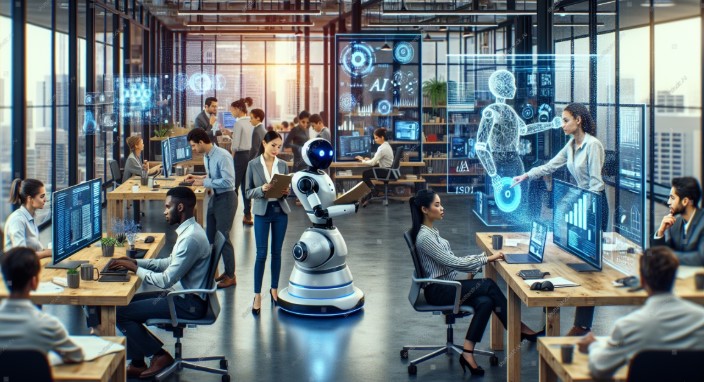
As enterprises approach 2026, Artificial Intelligence is no longer an add on capability. It is becoming a core operating layer embedded across business workflows, digital infrastructure, and decision-making processes.
Insights from Microsoft point to a clear inflection point. AI is evolving from assistive tools into collaborative systems that reason over enterprise data, execute actions across platforms, and continuously learn within governed environments. This shift represents a fundamental change in how organizations scale productivity, accelerate innovation, and maintain competitive advantage.
The future of enterprise AI will be defined by seven interconnected trends shaping 2026.
AI is no longer activated only when prompted. Instead, it operates continuously within enterprise systems, understanding context, anticipating needs, and participating directly in execution.
This positions AI as infrastructure rather than a collection of applications. Enterprises moving in this direction typically begin with a comprehensive AI strategy and cloud roadmap, aligning business priorities with technology outcomes. A foundational step for this is assessing how your data, processes, and cloud footprint support scalable AI adoption.
Learn how Cloud 9 guides strategy and planning:
AI agents are emerging as digital coworkers capable of coordinating workflows and executing multi step actions within defined guardrails. These agents interact with ERP, CRM, collaboration tools, and analytics platforms to complete tasks autonomously.
This model aligns with the concept of agentic AI and digital workers, where automation goes beyond simple tasks to reasoning, orchestration, and execution—unlocking measurable outcomes without burdening human teams.
Explore Cloud 9’s Agentic AI solutions:
As AI absorbs operational complexity, teams achieve higher output without linear increases in headcount. Human roles evolve toward strategy, creativity, and governance.
To make this shift sustainable, organizations must ensure enterprise data readiness for AI, where datasets are unified, governed, and ready to fuel advanced analytics and models.
The next phase of AI adoption emphasizes efficiency over raw scale. Distributed AI environments optimize compute utilization, energy consumption, and cost per workload.
Azure and Microsoft AI platforms provide scalable compute, identity management, and integrated governance allowing enterprises to deploy AI models and workloads securely and cost effectively.
AI is moving beyond analytics into direct participation in research and engineering. By generating hypotheses, simulating outcomes, and guiding experiments, AI dramatically shortens time to insight.
Industries such as healthcare and life sciences are already seeing measurable gains from AI assisted discovery and diagnostics.
This trend underscores how data and AI platforms serve as the foundation for modern innovation.
As AI agents gain autonomy, security must be embedded rather than layered on after deployment. Managed identities, scoped access, continuous monitoring, and compliance frameworks allow innovation to scale without increasing risk.
Cloud 9 integrates security and compliance across cloud and AI implementations:
AI systems now reason across entire environments rather than isolated snippets. At platforms like GitHub, repository aware intelligence enables earlier risk detection, improved reliability, and faster delivery across complex systems.
This trend enhances quality and predictability in engineering practices by embedding AI into development pipelines.
These trends are already delivering measurable impact.
Small marketing teams run global campaigns using AI driven analysis and personalization.
Engineering teams reduce rework and downtime using context aware AI across codebases.
By 2026, AI will no longer be evaluated as individual tools but as a foundational operating capability.
Together, these seven trends demonstrate how the shift from AI as assistance to AI as partnership delivers tangible enterprise value. Productivity scales without proportional headcount growth. Decision quality improves through contextual reasoning across data and workflows. Security and governance strengthen through built in safeguards. Infrastructure investments deliver higher returns through intelligent optimization. Innovation accelerates as AI compresses the path from experimentation to execution.
Organizations that want to move from insight to execution should begin with a structured assessment and modern cloud strategy.
Book an AI readiness and cloud strategy consultation:
The competitive advantage in 2026 will belong to enterprises that operationalize AI as a cohesive, secure, and scalable system. These organizations will not only improve efficiency but also expand what their teams can achieve and how quickly they can execute in an increasingly complex digital environment.
1. What does it mean to operationalize AI in the enterprise?
It means embedding AI directly into workflows, systems, and infrastructure so it operates continuously with governance and security built in.
2. How are AI agents different from traditional automation?
AI agents’ reason over context, adapt to change, and execute multi step tasks autonomously, unlike rule-based automation.
3. Is AI replacing human roles?
No. AI augments human capability by removing operational complexity and enabling higher value work.
4. How can enterprises adopt AI securely?
By designing AI systems with identity management, access controls, monitoring, and governance from day one.
Cloud 9 helps enterprises design, deploy, and scale Microsoft aligned AI and cloud solutions that move AI from experimentation to measurable business impact.